Trust & Safety
Is Chat Operator Work a Scam or a Real Job? 9 Red Flags to Check
Published: Updated:

Written by
Elena Marchenko— Head of HR
6 years in operator recruiting, 1,200+ interviews conducted at ChatQuip.
Quick answer
Chat operator work is a real, legal job: agencies like ChatQuip (founded 2018, 800+ active operators) pay $900–4,800 a month for it. But the niche attracts scammers who copy the job title to sell fake vacancies. The #1 red flag is any request for money — a real employer pays you, never the reverse.
I’m Elena Marchenko, Head of HR at ChatQuip. Over six years and 1,200+ interviews, one question has come up more than any other — usually in the first five minutes, usually asked a little apologetically.
“Is this actually real? Because the last ‘chat job’ I found asked me for $90 before I could start.”
I’ve stopped being surprised. Roughly every third candidate I talk to has already met a scammer wearing our profession as a costume. So instead of repeating the same answer interview after interview, I’m writing it down — the honest version, with everything I’d tell a friend.
Is chat operator work a scam or a real job?
It’s a real job. A chat operator answers messages on communication platforms on behalf of an agency — the same legal category of work as customer support or community moderation. Real companies hire for it, sign agreements for it, and pay for it every week.
ChatQuip has been doing exactly that since 2018. Today 800+ operators from 40+ countries work with us, earning between $900 and $4,800 a month depending on grade and hours — the average across all operators was $1,340 a month in Q2 2026. You can see how the whole system works, step by step, on our how it works page.
So why does the profession have such a shady reputation? Because the job title is easy to steal. Anyone can post “chat operator wanted, $200 a day, no experience” — no office, no product, no proof required. The vacancy costs a scammer nothing to fake, and the people it attracts are exactly the people least able to afford losing money.
The result: a real profession and a popular scam scheme sharing the same name. Your task is not to decide whether the job is real — it is. Your task is to check the specific employer in front of you.
Why do scammers love this niche?
When I ask candidates who were burned before how it happened, the stories rhyme. That’s because this niche hands scammers four gifts at once.
First, the audience is motivated and often desperate — students, parents on leave, people between jobs. When you urgently need income, your filters get quieter. Scammers know this and time their pressure accordingly.
Second, the job is genuinely remote and genuinely open to beginners, so “no experience needed, work from your phone” doesn’t sound suspicious — it’s what the real version looks like too. The lie hides inside a plausible wrapper.
Third, everything happens across borders and through messengers. A victim in one country, a “recruiter” in another, payment through crypto or a transfer — by the time you realize what happened, there’s nobody to knock on.
And fourth, victims stay quiet. People feel embarrassed about falling for a job scam, so they don’t report it, don’t warn others, and the scheme keeps working. The FTC’s guide to job scams describes the same mechanics across every industry — this niche is just an unusually comfortable home for them.
What are the 9 red flags of a fake employer?
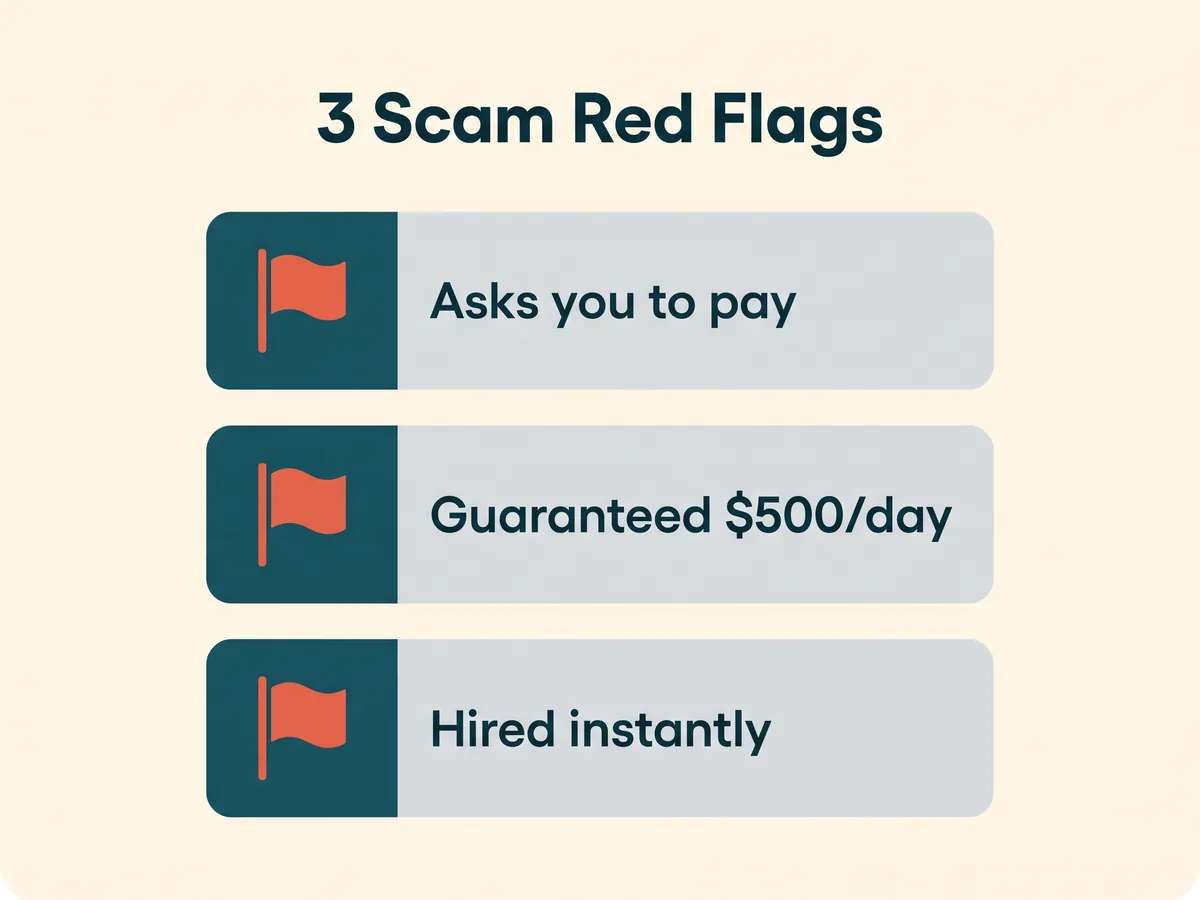
Here is my field guide — the nine patterns I’ve heard described in interviews over and over. One flag is a warning. Two or more mean walk away.
1. They ask you for money — any money, for any reason
Training fee, “starter kit”, account activation, refundable deposit, insurance. One candidate told me she paid $60 for “certification”, then $40 for “profile verification”, then was asked for $100 for “priority support” — the requests never end, because the requests are the business model. A real employer pays you. Money moving in the other direction, even once, even “refundable”, is the end of the conversation.
2. The salary is fantasy
“$8,000 a month, two hours a day, no experience.” I run hiring at an agency with eight years of payroll history, and I can tell you what this work actually pays: our range is $900–4,800, and the average is $1,340. A number ten times the market isn’t an opportunity you were lucky to find — it’s bait sized to make you stop thinking.
3. There’s no company you can google
The “employer” is a first name and a Telegram handle. No website, no legal entity, no terms of service, no team page — nothing that could be held accountable later. One applicant told me her previous “agency” existed entirely inside one group chat, which was deleted overnight along with two weeks of her unpaid work. If you can’t find who you’re dealing with, there is no one to deal with.
4. Your pay is locked behind a moving quota
“You’ll get your first payout after 1,000 messages.” Then at 1,000 it becomes “after quality review”. Then “after the monthly cycle closes”. The goalposts move because there was never a payout behind them. Real work pays on a fixed schedule for work actually done — at ChatQuip that means weekly, from a $50 minimum, with the first payout within 14 days.
5. They want your documents or card details before hiring you
A passport scan “for the contract”, card number “to set up payouts”, sometimes even banking logins “for verification”. I’ve interviewed a candidate who sent a passport photo to a fake recruiter and spent months dealing with loans taken out in her name. Payout details are needed after you start working — never as a condition of applying.
6. You must decide right now
“Only 2 spots left, the offer expires in an hour.” Urgency is not enthusiasm; it’s a tool designed to stop you from checking anything. In eight years I have never seen a legitimate vacancy that couldn’t wait a day for a candidate to think. A real offer survives your questions. A fake one can’t afford them.
7. Nobody can explain what the job actually is
Ask “what exactly will I be doing?” and you get slogans back: “easy chatting”, “just answer messages”, “everyone can do it”. Ask about platforms, metrics, or how pay is calculated, and the recruiter changes the subject. Vagueness is not laziness — it’s cover. There’s no job to describe.
8. Income is “guaranteed”
“Guaranteed $2,000 a month regardless of hours.” No honest employer can guarantee your income, because real earnings depend on how much and how well you work. When I quote our numbers to candidates, I quote ranges and averages — anything else would be a lie. A guarantee in a job ad is a sales script, not a contract term.
9. You’re “hired” without any interview
You send one message and get “Congratulations, you start tomorrow!” within minutes. I’ve conducted 1,200+ interviews precisely because a real agency needs to check your English, your typing, your fit — hiring costs us time and money, so we screen. A “job” that accepts absolutely everyone instantly isn’t hiring you. It’s queueing you for the fee request that comes next.
The cruelest part of this scheme is who it targets. The fake fee is always small enough to seem reasonable — $50, $90 — and it’s taken from people counting every dollar. That’s why my rule for candidates has one line: the moment anyone asks you for money, leave. Don’t negotiate, don’t clarify. Leave. — Elena
How do you verify an employer in 10 minutes?
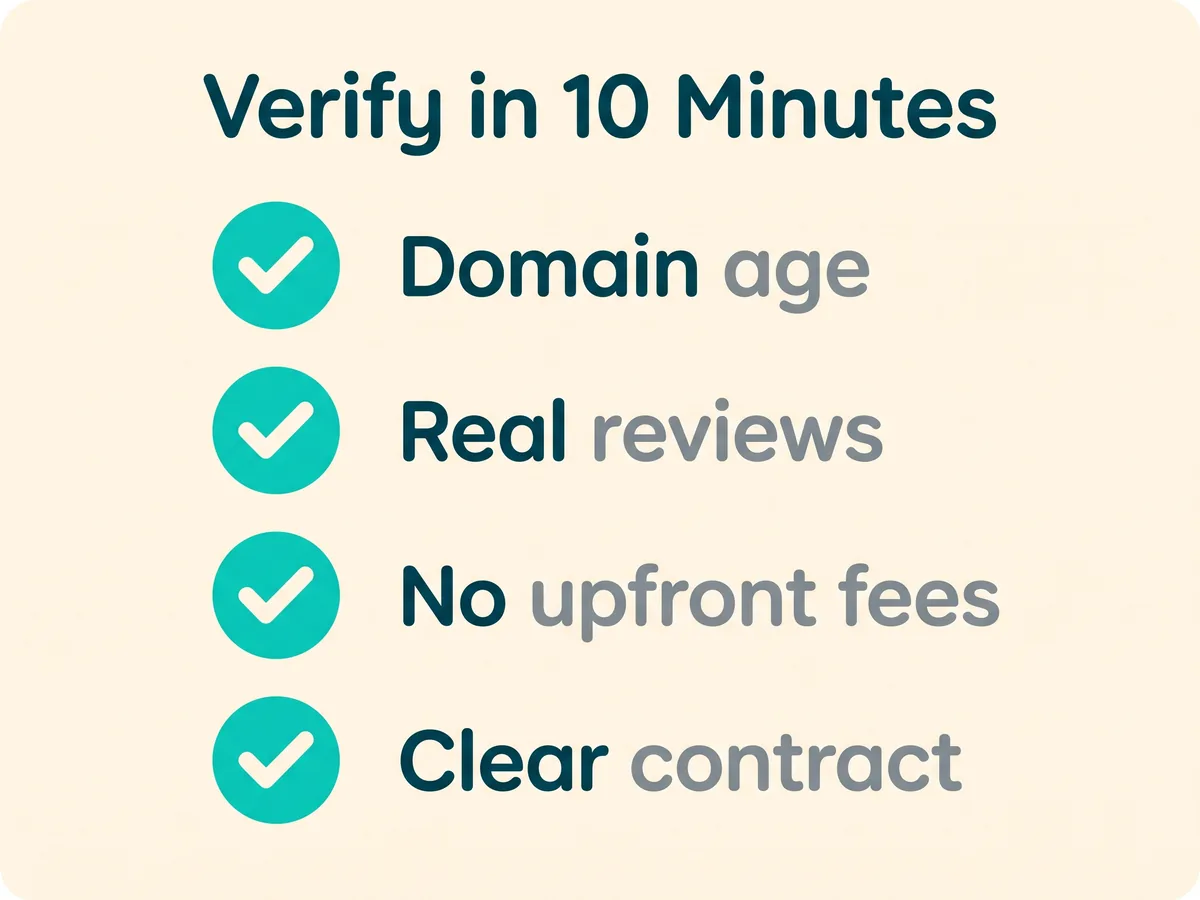
You don’t need to be an investigator. Five checks, ten minutes, and most fakes collapse on the first two.
- Google the brand name + “scam” and + “reviews”. A real agency has a footprint: reviews (including critical ones — a company with only perfect reviews is its own warning sign), mentions, history. A fake has either nothing or a trail of complaints.
- Look for legal pages. Published terms of service and a privacy policy, a real domain with some history, a named team you can actually address, and an explicit no-fee pledge. Scammers almost never bother building these, because their sites live for weeks.
- Ask the money question directly. “Do I pay anything at any stage — training, software, deposits, anything?” Watch the answer. A real recruiter says “no” in one word. A fake one says “well, there’s a small refundable…”
- Sanity-check the pay against the market. Compare the promised numbers with published real-world ranges — our salary reference table shows the full grade table. If the offer is several times higher, you’ve found flag #2.
- Ask for a real interview. A video or voice call with a named person who answers questions. Scammers avoid faces and specifics; recruiters with nothing to hide will happily spend 20 minutes with you.
What does a legitimate agency look like instead?

The simplest way to show the difference is side by side. Here’s each scam pattern next to how a real agency — ours, specifically — operates. Every row is something you can verify before committing to anything; our safety page walks through the full vetting checklist in more detail.
| Scam pattern | Legitimate practice (how ChatQuip works) |
|---|---|
| Fees for training or “activation” | Training is free, takes 5–10 days, and you already earn at Trainee grade ($250–400/mo) during it |
| Fantasy income promises | Published range $900–4,800/mo; real average $1,340/mo in Q2 2026 across 800+ operators |
| Anonymous Telegram “recruiter” | A brand operating since 2018, a named team, public terms and an agreement before you start |
| Payout after a moving quota | Weekly payouts, $50 minimum, first payout within 14 days |
| Instant “hiring” with no screening | A real application, a 20-minute interview and a test task — see the chat operator vacancy |
| ”Decide in 15 minutes” pressure | Take your time; ask any questions before you commit |
None of this makes us saints — it makes us checkable. That’s the entire point. Whoever you consider working with, apply the same table to them. And if you’d rather hear it from the operators themselves, our operator reviews collect named people with verifiable stories, not anonymous testimonials.
What should you do if you already paid a scammer?
First: this happens to smart people. Scam scripts are engineered by professionals who run them hundreds of times a day; you tested one unprepared. No shame — just act quickly.
Call your bank or card provider now. If you paid by card, ask about a chargeback for fraud — many payments can be disputed within 60–120 days. Bank transfers are harder but still worth reporting immediately. Crypto and gift cards are, honestly, usually gone — knowing that saves you from the next trap.
Report it. In the US, at reportfraud.ftc.gov; in the UK, via Action Fraud; elsewhere, your local cybercrime portal. One report rarely returns your money, but reports are how these schemes eventually get shut down.
Don’t chase the money through “recovery agents”. There’s a second-wave scam that targets scam victims: someone contacts you claiming they can recover your funds — for a fee. Nobody legitimate cold-messages fraud victims. Blocking them is the whole response.
Cut contact and protect your data. Stop replying, and if you sent documents, notify your bank and monitor for accounts opened in your name.
And then — don’t let one thief take the real profession from you too. The job exists, the pay is real, and now you know exactly how to check any employer, including us. Read how the work is structured, compare the numbers, ask me the hard questions in the interview. That’s what they’re for.
Frequently asked questions
Is chat operator work legal?
How can I tell a fake chat operator vacancy from a real one?
Do legitimate agencies charge for training?
Can I get my money back if I already paid a scam "fee"?
How much do real chat operators actually earn?
Ready to start earning?
Apply in 2 minutes — get a reply within 24 hours.
Apply NowRelated articles
Comparisons
Remote Chat Jobs in 2026: Every Type Compared, With Real Pay Ranges
A complete map of remote chat jobs you can do from home in 2026 — customer service chat support, chat moderation, entertainment chat operating, sales chat, and AI chat training — with realistic pay ranges, entry requirements, where to apply, and the scam patterns to avoid. By ChatQuip Head of HR Elena Marchenko.
Hiring Process
Chat Operator Interview: 12 Real Questions and How to Answer Them
What actually happens in a chat operator interview? Head of HR Elena Marchenko shares the 12 real questions she asks in 20-minute online interviews — with the reason behind each one, what a strong answer sounds like, and the red flags that make her say no.
Pay & Income
How Much Do Chat Operators Make? A Month-by-Month Reality Check (2026)
What does a chat operator actually earn in 2026? Head of HR Elena Marchenko breaks down the real pay by grade — Trainee $250–400 up to Senior $1,600+ — with a full grade table, an hour-by-hour income map, a week-by-week first-month story, and an honest comparison to other remote work.