Hiring Process
Chat Operator Interview: 12 Real Questions and How to Answer Them
Published: Updated:

Written by
Elena Marchenko— Head of HR
6 years in operator recruiting, 1,200+ interviews conducted at ChatQuip.
Quick answer
A chat operator interview is a 20-minute online conversation, and you usually get the invitation within 24 hours of applying. We assess four things: English (B1 or above), typing comfort, motivation, and reliability. No prior experience is required, and most candidates who prepare with the 12 questions below pass on the first try.
I’m Elena Marchenko, Head of HR at ChatQuip. Over more than 1,200 interviews I’ve learned that the people who walk in nervous are almost never the ones I end up turning down — the ones I turn down usually just weren’t ready, and that’s fixable in a single evening. So this is the article I wish every candidate read before we talked: the exact 12 questions I ask, why I ask them, what a strong answer sounds like, and the red flags that make me hesitate.
Nothing here is a trap. A chat operator interview at ChatQuip isn’t an exam you can flunk on a technicality — it’s a 20-minute conversation to check whether the work fits you and you fit the work. If you’d rather see the whole hiring path first, how it works lays out every step; this piece zooms all the way in on the interview itself.
How does the interview work?
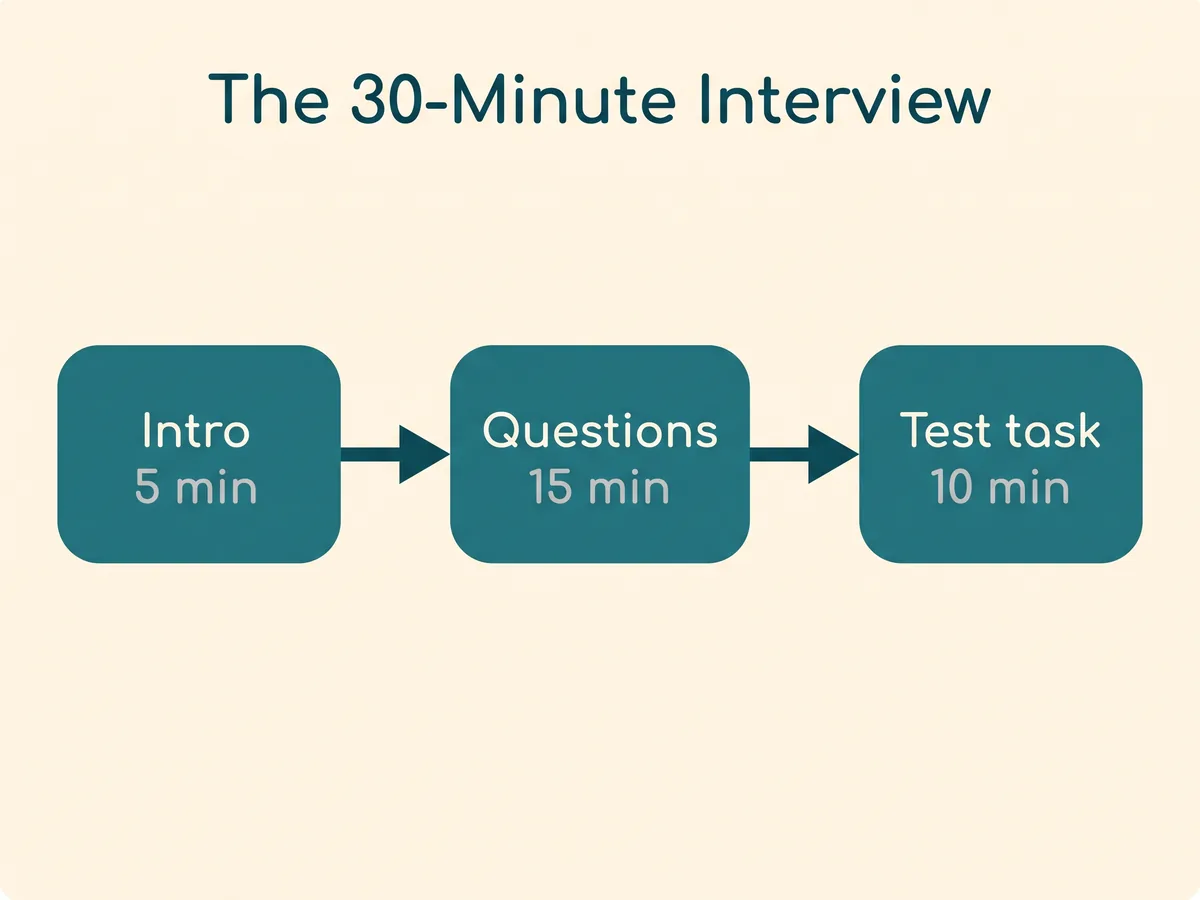
The format is deliberately simple. Once you apply, you get an invitation within 24 hours — usually much sooner. The interview is fully online, runs about 20 minutes, and you join from a phone or laptop at a time that suits you. There’s no group assessment, no waiting room full of other candidates, and no multi-round gauntlet. One conversation, one decision.
It’s my team who runs it — real recruiters who read every application personally, not a bot and not an automated video screen. That matters, because the whole point is a genuine back-and-forth. I want to hear how you think, not watch you recite.
A question I get constantly: do I need my camera on? For the interview itself, no — the camera is optional. Chat operating is written work, so most of what we assess lives in text, and plenty of great operators prefer to keep the camera off. What we’re really measuring across those 20 minutes is four things: your English (B1 or above is enough), your typing comfort, your motivation, and your reliability. Keep those four in mind and every question below makes sense.
The 12 real questions and strong answers

Here’s the core of it. These are the questions I actually ask, more or less in the order they come up. For each one I’ve written why it’s there, what a strong answer sounds like in a sentence or two, and what counts as a red flag on my side of the table. First, the map:
| # | Question | What it assesses |
|---|---|---|
| 1 | Tell me about yourself | Communication, English, fit |
| 2 | Why this job? | Motivation |
| 3 | Can you work evenings or nights? | Availability |
| 4 | How comfortable are you typing? | Typing / hard skill |
| 5 | How would you keep a conversation going? | Core chat skill |
| 6 | How do you handle a rude user? | Emotional resilience |
| 7 | How reliable is your schedule? | Reliability |
| 8 | How would you rate your English? | Self-awareness, English |
| 9 | Any previous experience? | Honesty (none is fine) |
| 10 | How long do you plan to stay? | Commitment |
| 11 | What are your pay expectations? | Realism |
| 12 | Do you have questions for us? | Engagement |
Now the detail.
1. Tell me about yourself. Why I ask: it’s the warm-up, and it’s my first real sample of your English and how you organise a thought. Strong answer: “I’m a student studying marketing, I’m online most evenings, and I’ve always been the friend who keeps group chats alive — so this felt natural.” Red flag: a memorised, over-formal monologue that sounds copied from a CV template, or an answer so short I have to drag every detail out.
2. Why do you want this job? Why I ask: motivation is the single best predictor of who’s still here in six months. Strong answer: something concrete — “I want flexible income around my classes and I genuinely enjoy chatting with new people.” Red flag: “because it’s easy money.” It isn’t, and that answer tells me you’ll quit the first slow week.
3. Can you work evenings or nights? Why I ask: our busiest, best-paying conversations happen in the evening across 40+ countries, so availability then is genuinely valuable. Strong answer: honest specifics — “I can do four evenings a week, roughly 8 to midnight.” Red flag: “any time, always, no problem” said too fast. Over-promising availability is the number-one thing new operators later break.
4. How comfortable are you typing? Why I ask: this is written work; slow, laboured typing makes the job stressful and the pay thin. Strong answer: “I don’t touch-type perfectly but I’m fast and accurate — I’m on a keyboard all day anyway.” Red flag: someone who’s never really typed on a full keyboard and expects to work only from a phone.
5. How would you keep a conversation going? Why I ask: this is the actual craft of the job. Strong answer: “I ask open questions, react to what they said instead of changing the subject, and I stay curious.” Red flag: one-word thinking — “I’d just reply to their messages.” Keeping a chat alive is a skill, and I need to hear that you get that.
6. How do you handle a rude user? Why I ask: it will happen, and I need to know you won’t take the bait or take it home with you. Strong answer: “I stay calm and polite, I don’t argue, and I steer the chat back to something friendly.” Red flag: “I’d tell them off” or, at the other extreme, visible panic. Neither survives a real shift.
7. How reliable is your schedule? Why I ask: reliability beats raw talent here — returning users and steady slots are how income grows. Strong answer: “I keep the same slots each week and I’ll tell you in advance if something changes.” Red flag: a vague “it depends day to day” with no anchor at all.
8. How would you rate your English? Why I ask: self-awareness matters as much as the level itself. Strong answer: “Probably solid B1, maybe B2 in writing — I read English every day but my speaking is rustier.” Red flag: “fluent, perfect” from someone whose written answers say otherwise. If you’re unsure of your level, a free self-check like the EF SET test settles it in under an hour.
9. Do you have any previous experience? Why I ask: honestly, mostly to put beginners at ease. Strong answer: “None in this, but I run a busy Discord community, so I’m always chatting.” No experience is completely fine — about 70% of our operators started with none. Red flag: an obviously invented history. I’d far rather hear “I’m new” than a fake résumé.
10. How long do you plan to stay? Why I ask: we invest 5–10 days of free training in you, so I want people looking past next week. Strong answer: “At least several months — I want to actually grow into the higher grades.” Red flag: “just until I find something else.” Everyone’s allowed to move on, but that framing tells me you won’t invest in the training.
11. What are your pay expectations? Why I ask: mismatched expectations are the saddest reason we part ways later. Strong answer: “I understand I start as a paid Trainee and grow from there — I’ve read the numbers.” Red flag: “I need $3,000 in my first month.” Our real ranges are on the salary page, and my pay-by-grade breakdown tells the story behind them; a grounded answer here is a green light.
12. Do you have any questions for us? Why I ask: the questions you ask reveal how seriously you’re taking this. Strong answer: anything thoughtful about shifts, training, or how pay grows. Red flag: “no, nothing.” A candidate who’s engaged always has at least one real question — even if it’s just “when could I start?”
What is the test task like?
After we’ve talked, I’ll ask you to do a short, two-part test task. It takes only a few minutes and it’s the closest thing to a real shift you’ll do before training.
The first part is a quick typing check — a couple of sentences to type out so I can see your speed and, more importantly, your accuracy. I’m not timing you against a world record; I just need to know a keyboard isn’t a struggle. If you want to warm up beforehand, a free tool like 10FastFingers tells you exactly where you stand.
The second part is a situational chat. I’ll play a user and send you a normal opening message, then a slightly awkward one, and I’ll watch how you keep the conversation warm, natural, and moving. What I’m measuring is clear and simple: correct, friendly English; whether you ask questions back instead of letting the chat stall; and whether you stay composed when a message is a little off. I’m not looking for perfection or clever tricks — I’m looking for someone I’d be happy to have talking to real users next week.
Top-5 reasons we say no
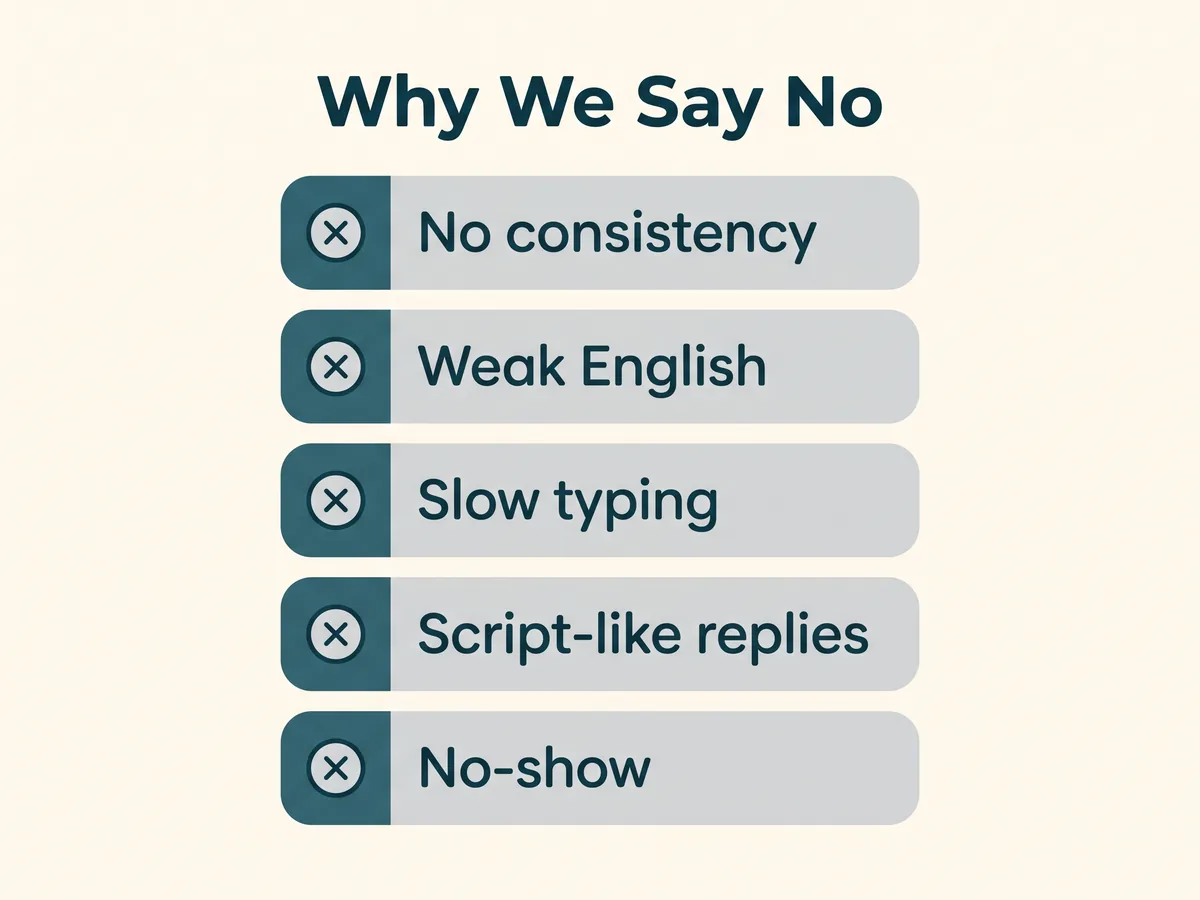
I’d rather be transparent about the failure modes than have you guess. After 1,200+ interviews, almost every rejection I’ve made falls into one of five buckets — and every single one is avoidable.
- No-shows. Missing the interview without a word is the fastest no there is. This job is built on reliability, and not turning up is the loudest possible signal that you won’t be reliable on shift either.
- Expecting a big income from day one. Candidates who open with “how do I make $3,000 this month” have usually been sold a fantasy elsewhere. Everyone starts as a paid Trainee and grows; if that’s a dealbreaker, we’re not the fit.
- English clearly below B1. If I can’t follow your written answers, users won’t be able to either. This isn’t a judgement on you as a person — it’s the one hard requirement, and it’s improvable. Come back when you’ve closed the gap.
- No consistent availability. “Whenever” isn’t a schedule. If you can’t point to any regular slots, the work won’t build income for you and you’ll drift away frustrated.
- A rude or cold tone in the test. If the situational chat turns sharp, dismissive, or flat, that’s a preview of how a real user would feel. Warmth is the product here.
Notice that none of these are about being smart enough or experienced enough. They’re about reliability, realism, and tone — and you control all three.
How to prepare in one evening
You genuinely don’t need days for this. Here’s the checklist I’d hand a friend the night before:
- Check your English level honestly. Run the free EF SET test so you can name your level with confidence instead of guessing in the interview.
- Do a two-minute typing warm-up so your hands are loose and you know your speed.
- Decide your real availability before we talk — actual evenings and hours you can commit to, not a hopeful “any time.”
- Read the numbers on the salary breakdown so your pay expectations are grounded and question 11 is easy.
- Skim how to become a chat operator to walk in already understanding the training, grades, and payouts.
- Prepare one genuine question for the end — it’s the easiest way to finish strong.
- Test your setup: stable internet, a full keyboard if you have one, and a quiet 20 minutes.
Do those seven things and you’ve handled everything I’ve ever seen sink a prepared candidate. If you’re still unsure about anything, our FAQ answers the rest.
That’s the whole interview, laid bare. It isn’t a filter designed to trip you up — it’s 20 minutes for me to check that the English is there, the hours are real, and the tone is warm, then to hand the confident ones straight to training. If that sounds like you, the chat operator vacancy is open, and I might well be the one across the screen. Come ready to ask me something — the candidates who do are almost always the ones I say yes to.
Frequently asked questions
How long is the chat operator interview and what format is it?
Do I need experience to pass the interview?
What is the test task and can I fail on it?
What makes you reject a candidate?
Ready to start earning?
Apply in 2 minutes — get a reply within 24 hours.
Apply NowRelated articles
Comparisons
Remote Chat Jobs in 2026: Every Type Compared, With Real Pay Ranges
A complete map of remote chat jobs you can do from home in 2026 — customer service chat support, chat moderation, entertainment chat operating, sales chat, and AI chat training — with realistic pay ranges, entry requirements, where to apply, and the scam patterns to avoid. By ChatQuip Head of HR Elena Marchenko.
Pay & Income
How Much Do Chat Operators Make? A Month-by-Month Reality Check (2026)
What does a chat operator actually earn in 2026? Head of HR Elena Marchenko breaks down the real pay by grade — Trainee $250–400 up to Senior $1,600+ — with a full grade table, an hour-by-hour income map, a week-by-week first-month story, and an honest comparison to other remote work.
Trust & Safety
Is Chat Operator Work a Scam or a Real Job? 9 Red Flags to Check
Chat operator work is a real, legal job — but the niche is crawling with fake "employers". Head of HR Elena Marchenko explains the 9 red flags she hears about in interviews, how to vet any agency in 10 minutes, and what to do if you already paid a scammer.