Pay & Income
How Much Do Chat Operators Make? A Month-by-Month Reality Check (2026)
Published: Updated:

Written by
Elena Marchenko— Head of HR
6 years in operator recruiting, 1,200+ interviews conducted at ChatQuip.
Quick answer
A chat operator earns from $250–400 a month as a Trainee up to $1,600+ as a Senior, and the average across 800+ ChatQuip operators was $1,340 a month in Q2 2026 (internal data). Your income depends on two things: your grade and how many hours a day you work.
I’m Elena Marchenko, Head of HR at ChatQuip. In over 1,200 interviews, the question that comes up more than any other is the plainest one: “So how much will I actually make?”
It’s a fair question, and most answers online are useless — either a shrug or a screenshot of a fantasy $8,000 month. So let me do the thing the internet rarely does with this profession: give you the real numbers, where they come from, and how they change as you grow.
Everything below comes from our own Q2 2026 payroll data across 800+ active operators. If you want the reference tables in one place, our salary page has them; this article is the story behind the numbers — the progression, the first month, the trade-offs.
How much does a chat operator make?
The short answer: from $250–400 a month as a Trainee up to $1,600 and beyond as a Senior. The average across all 800+ of our operators was $1,340 a month in Q2 2026.
That average hides a lot of range, though, because pay is organised into four grades. Everyone starts as a paid Trainee and moves up as their chats get stronger and their hours stay consistent. Here is the full picture:
| Grade | Monthly range | Typical time to reach | Share of operators |
|---|---|---|---|
| Trainee | $250–400 | From day one (during training) | 20% |
| Junior | $500–800 | ~2 months | 35% |
| Middle | $900–1,400 | ~6 months | 30% |
| Senior | $1,600–4,800 | ~12 months | 15% |
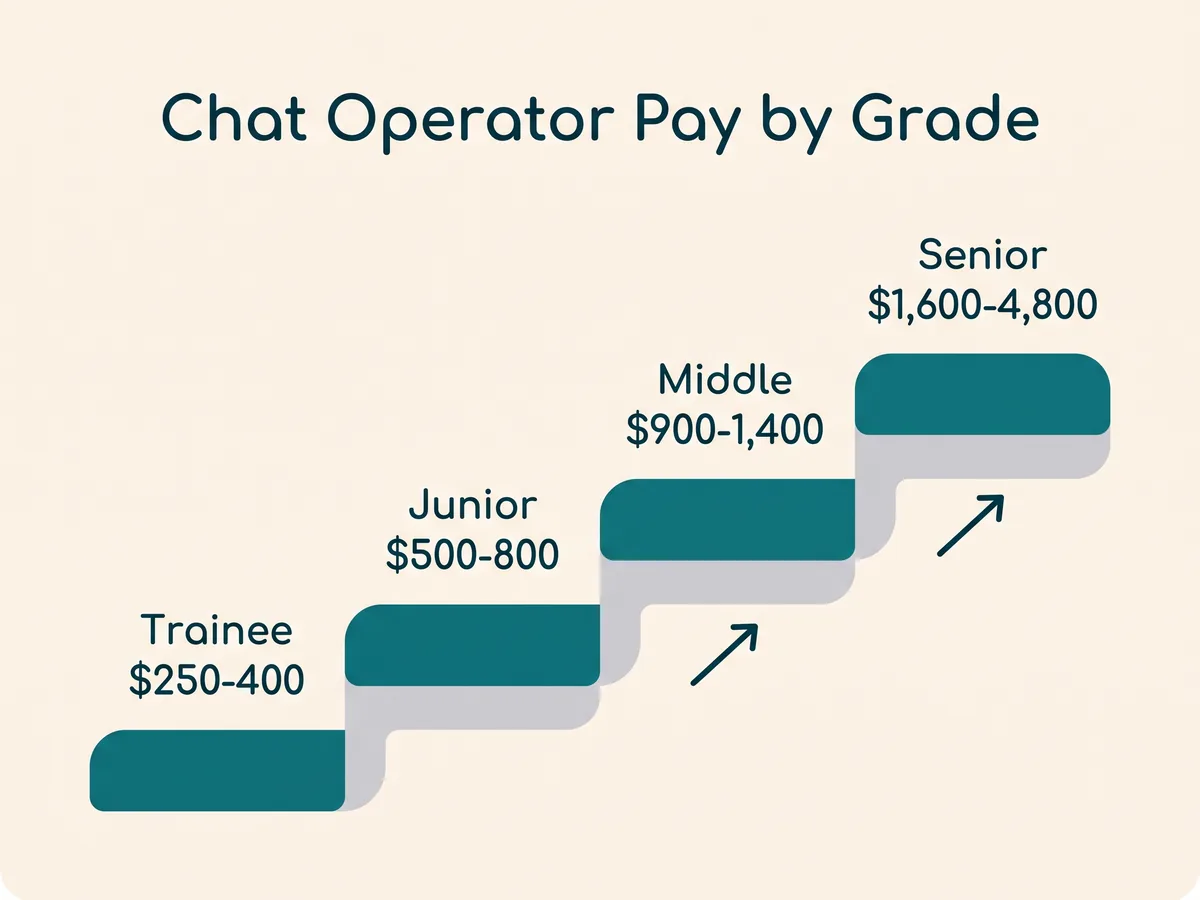
Two things to read out of this table. First, nobody stays a Trainee — it’s the paid learning phase, and 80% of our operators have already climbed past it. Second, the grades are the single biggest lever on your income. The gap between Junior and Senior is far larger than the gap two extra hours a day makes. If you want to earn more, the highest-return move is to keep climbing grades.
A quick note on a number you’ll see everywhere on our site: a typical Junior earns around $650 a month. That’s the mid-point of the Junior band — where a steady operator on moderate hours lands. It is not tied to any particular shift length; where you sit inside your band depends on hours and consistency, which I’ll break down below.
What does the income consist of?
Your monthly pay isn’t a flat salary. It’s built from a few parts, and understanding them tells you exactly what to push on.
The base is a hybrid of per-message and hourly work. You’re paid for the conversations you handle, with the hourly frame making sure your time is protected even on a slow platform. This is why hours matter so directly: more time online, within your grade, means more base pay.
On top of the base sit bonuses, and this is where two operators at the same grade start to diverge. There are bonuses for consistency — keeping the same weekly slots, showing up when you said you would — and bonuses for quality, measured by how engaging your chats are, i.e. how long users keep replying to you. A Middle who nails both can out-earn a Middle who just clocks hours.
It’s worth being honest about how the money reaches an agency in the first place, because that’s what makes this sustainable. We work with several partner platforms, and they pay the agency for the volume and quality of conversation our operators produce. The agency’s job is to train you, route you to the right conversations, and pay you weekly — which is why an agency can afford to pay a Trainee while they learn, and why real work never asks you to pay anything up front. (If you’ve been asked to pay a “training fee” somewhere, read is chat operator work a scam or real — that’s the #1 red flag.)
One more thing worth saying plainly: nothing is deducted on your side. You’re an independent contractor, so you handle your own taxes under your country’s rules — but there are no joining fees, no platform cut skimmed off your balance, and no fines. The number in your dashboard is the number that reaches your account. That matters when you compare offers, because a slightly higher headline rate elsewhere can quietly shrink through deductions you only discover on payday.
What does the first month look like?

Numbers on a table are abstract, so let me walk through a real first month, week by week — the shape it takes for most people who start with us.
Week 1 — training. Training is free and takes 5–10 days. You learn the platforms, the style, how pay is calculated, and you practise on real-feeling scenarios. Crucially, you’re already at the Trainee grade here, so you’re earning $250–400 while you learn rather than working for free.
Week 2 — first shifts. You move onto real conversations, usually on gentler platforms and shorter slots while you find your rhythm. This is the wobbly week — everyone’s typing feels slow and every chat takes thought. It smooths out fast.
Weeks 3–4 — finding a groove. By now your slots are steadier, your chats flow, and your numbers start to look like a Junior’s rather than a Trainee’s. Your first payout lands within 14 days of your first paid shift, then continues weekly — a short cash cycle that, honestly, is the thing most new operators tell me kept them motivated. Seeing real money in week two beats waiting a month.
By the end of month one, a committed starter is typically settling into the $500–800 Junior band, with a clear sense of what a good shift feels like and what it pays.
How do you grow from Trainee to Senior?
The grade table above gives the headline timeline: roughly 2 months to Junior, 6 to Middle, 12 to Senior. But those are averages, and the interesting question is what actually moves you along.
Three things, in order of impact:
-
Consistency. The single biggest predictor of who climbs fast. Operators who hold the same weekly slots build rapport with returning users, get matched to warmer conversations, and accumulate the consistency bonuses that lift them within a band and then over the line into the next grade.
-
Engagement quality. Grades don’t move on volume alone — they move on how well your chats hold attention. Learning to write messages that people actually want to reply to is the skill that separates a Middle from a Junior.
-
Platform range. As you get comfortable, covering more platforms and busier slots (evenings, weekends) exposes you to higher-paying conversation and the upper half of each band.
Notice that all three are within your control. You can’t skip grades overnight, but you decide how consistent you are, how much care goes into each chat, and how much range you build. The operators who reach Senior on the faster end aren’t more talented — they’re more deliberate. Today 30% of our people are at Middle and 15% at Senior, so the upper bands are a realistic destination, not a lottery.
Let me put a face on that timeline. One operator I onboarded last spring — a student juggling classes — started nervous and slow, barely clearing Trainee numbers in her second week. What she did right was boring and decisive: she picked four fixed evening slots and never missed them. By month two she was a comfortable Junior around $650; by month six her engagement scores had pulled her into Middle at roughly $1,150 on those same six-hour evenings. She never added hours — she added consistency and craft. That’s the pattern behind almost every fast climb I’ve watched, and it’s a far more reliable route to Senior than trying to muscle it with raw time online.
How many hours do you need?
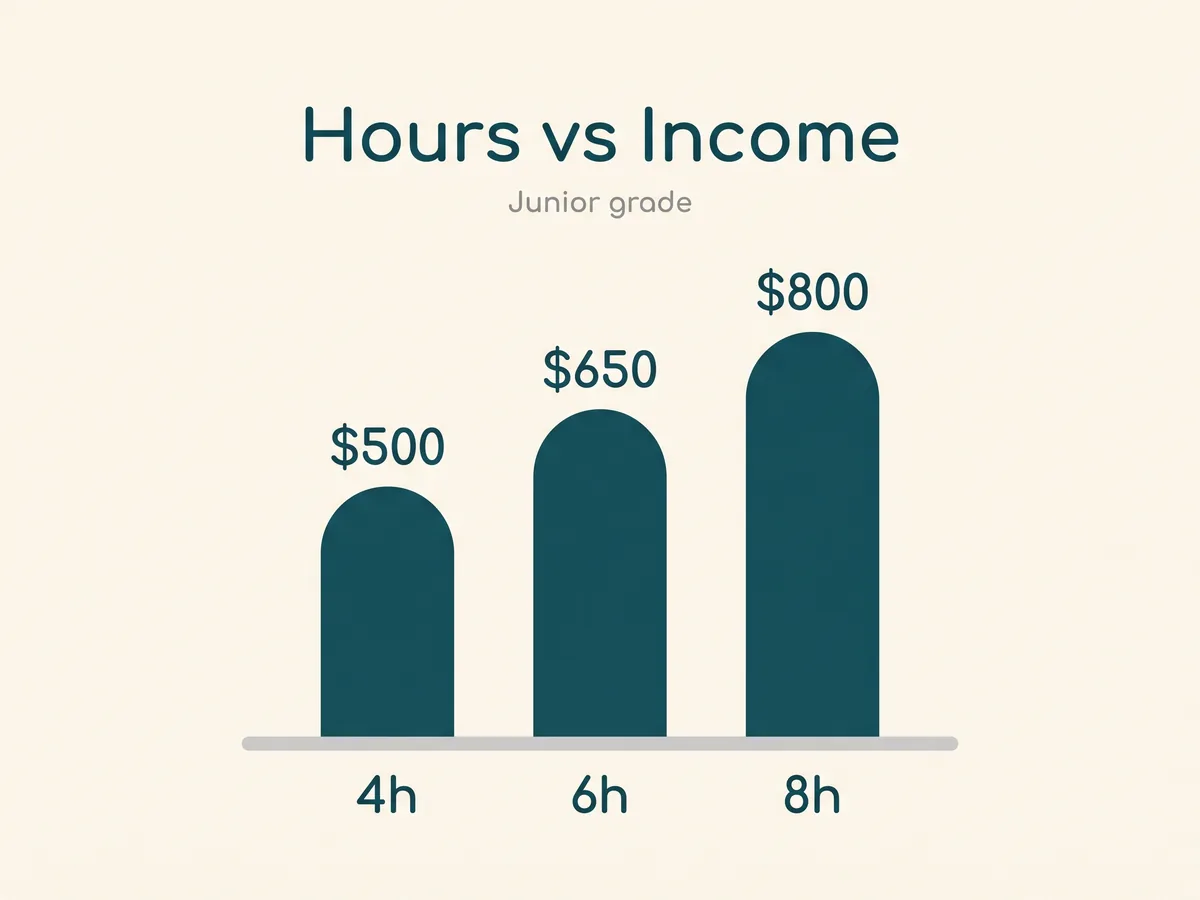
The floor is 4 hours a day. From there, monthly pay scales almost linearly, which lets us map earnings cleanly. The rule we use across the site: 4 hours sits at the bottom of your grade band, 6 hours in the middle, 8 hours at the top.
| Hours/day | Junior | Middle | Senior |
|---|---|---|---|
| 4 h | $500 | $900 | $1,600 |
| 6 h | $650 | $1,150 | $3,200 |
| 8 h | $800 | $1,400 | $4,800 |
Read this as a progression, not a fixed menu. In your first months as a Junior, a 4-hour day brings in around $500 and a full 8-hour day around $800. Reach Middle and the same 6-hour day roughly doubles to $1,150, with full-time hours pushing $1,400. By Senior the range widens sharply, because top operators combine long hours, high engagement, and the best-paying platforms — which is how the 8-hour Senior figure reaches $4,800.
A caveat I always add: almost nobody works an 8-hour Senior day every single day. That column shows the ceiling the grade makes possible, not a routine. Most people find a sustainable middle — six focused hours on consistent slots — and let grade progression, not brute hours, do the heavy lifting on their income.
How does it compare to other remote work?
I’d rather you make an informed choice than take my word for it, so here’s an honest comparison with other entry-level remote roles. The figures for other jobs are conservative market estimates that vary a lot by country and experience — cross-check them against public aggregators like Payscale and remote-work surveys like Buffer’s State of Remote Work.
| Role | Entry barrier | Typical $/month | Schedule |
|---|---|---|---|
| Chat operator (ChatQuip) | No experience, English B1+ | $900–4,800 | Very flexible — you pick |
| Customer support | Training, fixed shifts | $1,000–2,500 | Rigid |
| Freelance copywriter | Portfolio required | $800–3,000 | Flexible, but you chase clients |
| Online tutor | Subject expertise, often a degree | $600–2,000 | Booked around students |
The headline pay is broadly comparable — most of these cluster in the $800–2,500 range for someone starting out. What sets chat operating apart is the combination: you can begin with no portfolio, no degree, and no fixed schedule, and still reach the same money a copywriter or support agent earns, with a clearer, defined path to the higher grades. For students, parents, and anyone fitting work around something else, that flexibility is often worth more than a slightly higher headline rate on a rigid schedule. If you’re still weighing the field, my roundup of the top remote jobs you can start with no experience puts chat work side by side with the alternatives.
That’s the whole picture, and I’ve deliberately kept it in ranges rather than promises, because ranges are what an honest employer can actually stand behind. If you want to see the reference tables side by side, they live on the real pay ranges by grade; if you’d rather see whether the numbers land on your own dashboard, the open chat operator role is open, and how the whole system works step by step. Come ask me the hard questions in the interview — the pay is exactly why they’re worth asking.
Frequently asked questions
How much does a chat operator earn per month in 2026?
How long does it take to reach the higher-paying grades?
How many hours a day do I need to work?
How does chat operator pay compare to other remote jobs?
When do I get my first payout?
Ready to start earning?
Apply in 2 minutes — get a reply within 24 hours.
Apply NowRelated articles
Comparisons
Remote Chat Jobs in 2026: Every Type Compared, With Real Pay Ranges
A complete map of remote chat jobs you can do from home in 2026 — customer service chat support, chat moderation, entertainment chat operating, sales chat, and AI chat training — with realistic pay ranges, entry requirements, where to apply, and the scam patterns to avoid. By ChatQuip Head of HR Elena Marchenko.
Hiring Process
Chat Operator Interview: 12 Real Questions and How to Answer Them
What actually happens in a chat operator interview? Head of HR Elena Marchenko shares the 12 real questions she asks in 20-minute online interviews — with the reason behind each one, what a strong answer sounds like, and the red flags that make her say no.
Trust & Safety
Is Chat Operator Work a Scam or a Real Job? 9 Red Flags to Check
Chat operator work is a real, legal job — but the niche is crawling with fake "employers". Head of HR Elena Marchenko explains the 9 red flags she hears about in interviews, how to vet any agency in 10 minutes, and what to do if you already paid a scammer.