Comparisons
Top 7 Remote Jobs Without Experience in 2026 (With Real Pay Ranges)
Published: Updated:

Written by
Elena Marchenko— Head of HR
6 years in operator recruiting, 1,200+ interviews conducted at ChatQuip.
Quick answer
The seven realistic remote jobs you can start with no experience in 2026 are: chat operator ($900–4,800/mo, ChatQuip data), customer support ($1,000–2,500), data annotation / AI training ($400–1,800), freelance translation ($800–2,800), content moderation ($1,000–2,200), virtual assistant ($800–2,500), and online tutoring ($600–2,000). Pay varies a lot by hours worked, country, and skill — the higher numbers assume near-full-time hours or a rare skill. Chat operator ranks first for fast start, weekly pay, and no portfolio; the rest are conservative market estimates.
I’m Elena Marchenko, Head of HR at ChatQuip. Every week I read messages from people who want to start working remotely but have no experience, no portfolio, and no idea which of the hundred “make money online” promises are real. So I built this list the way I’d want it built for my own sister: seven jobs you can genuinely start from zero in 2026, with pay ranges I can stand behind rather than screenshots of fantasy months.
A word on honesty before we start. I run a chat operator agency, so yes, chat operator is number one — but I’ve included the real competing platforms for every other job on this list too. If I only pushed my own category and hid the alternatives, you’d be right not to trust the numbers. The whole list is more useful, and more trustworthy, when it’s complete.
How I ranked these. Four things, in order: entry barrier (can a real beginner get hired this month?), realistic income (what a part-timer actually clears, not the ceiling), schedule flexibility (can you fit it around study or kids?), and payout speed (how fast and how often the money reaches you). Only ChatQuip’s numbers come from our own payroll; every other figure is a conservative market estimate that swings a lot by country, hours, and skill. Read them as ranges, not promises.
1. Chat operator
What it is. You chat on behalf of profiles on messaging and dating-style platforms, keeping conversations engaging and human. It’s writing-based customer engagement — no calls, no camera, no sales scripts. You’re paid for the conversations you handle, on a hybrid of per-message and hourly work, plus bonuses for consistency and quality.
Why it’s #1. Nothing else on this list combines such a low barrier with such fast money. There’s no portfolio, no degree, and no fixed schedule — you pick your slots. English at B1 is enough. Training is free and paid (you earn as a Trainee from day one), the first payout lands within 14 days, and then it’s weekly. Across our 800+ operators, pay runs $900–4,800 a month, with the average around $1,340 in Q2 2026. That mix of speed, flexibility, and a clear path from Trainee to Senior is exactly why it tops the list.
Realistic pay. $900–1,400 a month is the honest middle for someone working consistent part-time hours; $1,600+ is the Senior band, and $4,800 is the ceiling for near-full-time hours at top quality. See the full breakdown on our pay-by-grade page.
Entry barrier. Low. 18+, English B1+, a PC or laptop, stable internet. About 70% of our operators started with no experience at all.
Where to look. Our own operator position is open, and the guide on how to become a chat operator walks through applying. Only work with agencies that pay you — never one that charges a “training fee.”
Honest cons. The work is repetitive, and demand peaks in the evenings and at night, so the best-paying slots aren’t 9-to-5. It also isn’t for everyone — you need to enjoy writing and stay warm across dozens of conversations. Pros: fast weekly pay, genuinely flexible, no experience needed, clear progression. Cons: repetitive, evening/night demand, requires steady typing and emotional stamina.
2. Customer support agent

What it is. You answer customer questions over live chat, email, or tickets for a company or an outsourcing partner — resolving orders, refunds, and how-to questions from a knowledge base. It’s the classic entry point into remote work.
Realistic pay. Roughly $1,000–2,500 a month, depending heavily on country and whether you’re part- or full-time. Non-native-English regions sit lower; native, full-time roles reach the top.
Entry barrier. Low to medium. You’ll usually pass a short assessment and a training week, and many roles want fluent, near-native written English.
Where to look. Established remote-first support employers like LiveWorld, ModSquad, and SupportNinja hire beginners; general boards like We Work Remotely and Remote OK list dozens weekly.
Honest pros/cons. Pros: stable monthly pay, real career ladder into QA and team lead roles, transferable skills. Cons: fixed shifts (often including weekends and holidays), scripted responses, and metrics pressure on handle time and satisfaction scores.
3. Data annotation / AI training contributor
What it is. You label data that trains AI models — tagging images, transcribing audio, rating chatbot answers, or writing example responses. As AI demand has grown, so has the need for human raters and annotators.
Realistic pay. Wide and uneven: $400–1,800 a month part-time. Simple micro-tasks pay little; specialist work (coding evaluation, expert-domain rating) pays far more per hour. Work also comes in waves — busy one month, quiet the next.
Entry barrier. Very low for basic tasks; higher-paying projects screen for a specific skill or degree.
Where to look. Appen, Scale AI’s Remotasks, Outlier, and Toloka are the main platforms. Watch reviews on payout reliability — the space has a mixed reputation, so start small before committing hours.
Honest pros/cons. Pros: truly no experience needed to start, fully asynchronous, work whenever. Cons: unstable volume, sometimes low effective hourly rate, and occasional payment or account-suspension complaints — treat it as a supplement, not a guaranteed salary.
4. Freelance translation
What it is. You translate text between two languages you know well — documents, subtitles, marketing copy, or app strings. If you’re genuinely bilingual, this turns a skill you already have into income.
Realistic pay. $800–2,800 a month, driven by your language pair and volume. Rare pairs and specialist fields (legal, medical, technical) pay well above common ones. It’s project-based, so income is lumpy until you build repeat clients.
Entry barrier. Medium. No degree required to start on marketplaces, but you’ll need real fluency in both languages (roughly B2+) and to pass a test.
Where to look. Gengo and Smartcat’s marketplace onboard beginners with a qualification test; ProZ and Upwork host higher-value direct clients once you have a few jobs behind you. At ChatQuip we also hire translators directly.
Honest pros/cons. Pros: uses an existing skill, flexible, scales with reputation. Cons: you compete on price early on, machine translation has squeezed low-end rates, and income is uneven until clients repeat.
5. Content moderation
What it is. You review user-generated content — posts, images, comments, videos — against platform rules, removing what breaks them. Every large platform needs moderators, and much of the work is fully remote.
Realistic pay. About $1,000–2,200 a month, similar to customer support, with full-time roles at the top of the range.
Entry barrier. Low to medium. Good written English and reliability matter more than credentials; expect a screening test and training.
Where to look. ModSquad, TELUS International, and Majorel are common entry points, plus BPO firms hiring for specific platforms.
Honest pros/cons. Pros: steady demand, clear guidelines, no client-chasing. Cons: you may be exposed to disturbing content (ask about wellbeing support before you accept), the work is repetitive, and shifts are usually fixed.
6. Virtual assistant
What it is. You handle administrative tasks remotely for a business or busy professional — inbox and calendar management, scheduling, data entry, research, light bookkeeping. It’s varied and relationship-based.
Realistic pay. $800–2,500 a month part-time, rising as you specialize (a VA who does bookkeeping or paid-ads support earns more than one doing pure admin).
Entry barrier. Low to medium. No formal qualification, but you need to be organized, communicative, and comfortable with common tools (Google Workspace, a scheduler, maybe a CRM).
Where to look. Agencies like Belay, Time etc, and Fancy Hands match beginners with clients; direct clients appear on Upwork and OnlineJobs.ph.
Honest pros/cons. Pros: varied work, close client relationships, easy to grow into higher-paid niches. Cons: you’re often on someone else’s clock and time zone, tasks can be scattered, and one demanding client can dominate your week.
7. Online tutoring
What it is. You teach a subject or language over video — English conversation, school subjects, exam prep, or a professional skill. If you already know something well, you can teach it.
Realistic pay. $600–2,000 a month, depending on subject, hourly rate, and how many hours you can fill. Language tutoring for beginners sits lower; certified subject tutors and exam coaches earn more per hour.
Entry barrier. Medium to high — the highest on this list. Better-paying platforms want subject expertise and often a teaching certificate (like a TEFL/TESOL for English).
Where to look. Preply and italki let you start language tutoring with a strong profile; Cambly is lower-barrier conversation practice; academic platforms want credentials.
Honest pros/cons. Pros: rewarding, good hourly rates once established, builds a real teaching skill. Cons: you must fill your own schedule (empty slots pay nothing), students book around their own lives — often evenings — and the best rates need certification.
The 7 at a glance
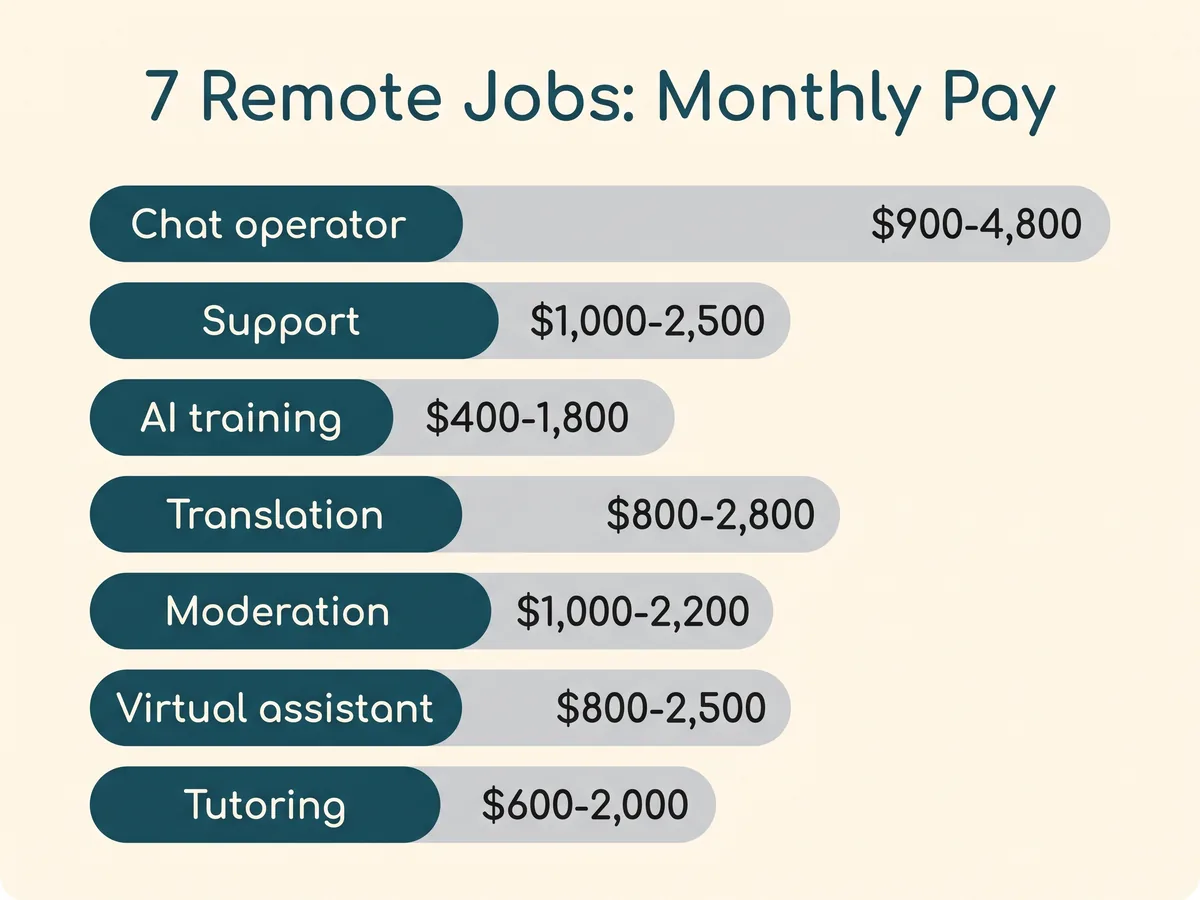
| # | Job | Typical $/mo (part-time) | Entry barrier | Schedule | Payout speed |
|---|---|---|---|---|---|
| 1 | Chat operator (ChatQuip) | $900–4,800 | Low — B1 English | Very flexible, you pick | Weekly, first in 14 days |
| 2 | Customer support | $1,000–2,500 | Low–medium | Fixed shifts | Monthly |
| 3 | Data annotation / AI | $400–1,800 | Very low | Fully async | Per-project / weekly |
| 4 | Freelance translation | $800–2,800 | Medium — B2+ | Flexible, project-based | Per-project |
| 5 | Content moderation | $1,000–2,200 | Low–medium | Fixed shifts | Monthly |
| 6 | Virtual assistant | $800–2,500 | Low–medium | Client’s hours | Weekly / monthly |
| 7 | Online tutoring | $600–2,000 | Medium–high | You fill your slots | Weekly / per lesson |
Numbers for jobs 2–7 are conservative market estimates that vary widely by country, hours, and skill — cross-check them against public aggregators like Payscale and freelance-rate data on Upwork’s resource hub. Only the chat operator figures come from ChatQuip’s own payroll.
Which one should you choose?
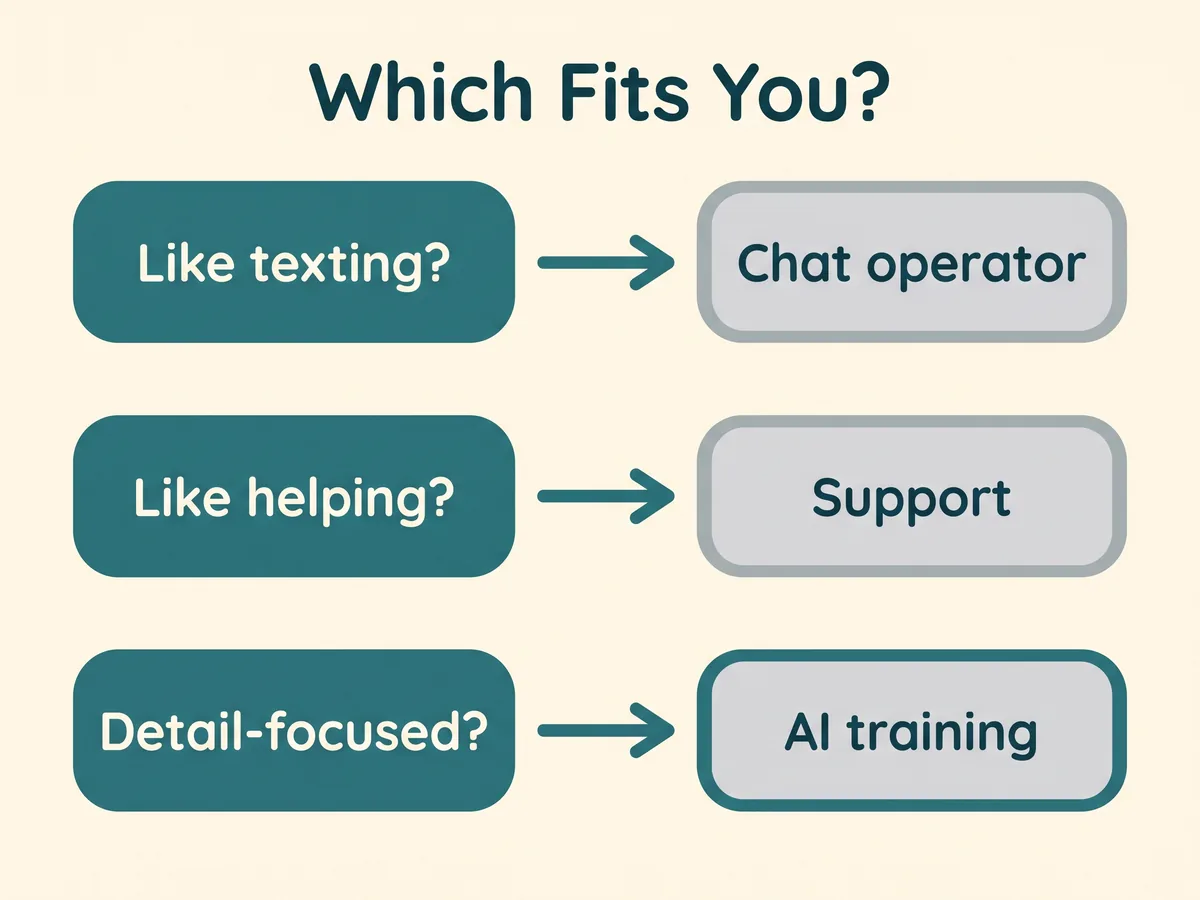
There’s no single best job here — there’s a best fit. Here’s how I’d guide the three people who message me most.
A student who needs money now and studies during the day. Go with chat operator. You have B1+ English, you want a fast start and weekly pay, and evening/night demand actually matches your free hours. Data annotation is a decent supplement between exam seasons because it’s fully asynchronous.
A parent fitting work around a small child. Flexibility and payout speed matter most, and unpredictable interruptions rule out fixed shifts. Chat operator or virtual assistant both let you shape your own hours; a VA role suits you if you’re highly organized and want steadier client relationships, while chat operating pays faster and needs no prior office skills.
Someone who has relocated and needs stable income fast. If your English is B1+ and you want money in two weeks, chat operator is the quickest on-ramp. If you’re genuinely bilingual, freelance translation turns that into an asset. If you hold a teaching certificate, online tutoring will pay you more per hour than anything else on this list — it just takes longer to fill your schedule.
Match the job to your reality — your English level, your free hours, how fast you need cash, and any skill you already carry. If a low barrier, real flexibility, and weekly pay describe what you’re after, start with the chat operator role; the salary breakdown and my pay-by-grade article show exactly what the numbers look like month by month. Whatever you pick, choose the one that fits your life — that’s the job you’ll still be doing, and getting better paid for, six months from now.
Frequently asked questions
What is the easiest remote job to start with no experience in 2026?
Which remote job pays the most without experience?
Do I need a degree for any of these remote jobs?
How fast can I actually get paid?
Ready to start earning?
Apply in 2 minutes — get a reply within 24 hours.
Apply NowRelated articles
Comparisons
Remote Chat Jobs in 2026: Every Type Compared, With Real Pay Ranges
A complete map of remote chat jobs you can do from home in 2026 — customer service chat support, chat moderation, entertainment chat operating, sales chat, and AI chat training — with realistic pay ranges, entry requirements, where to apply, and the scam patterns to avoid. By ChatQuip Head of HR Elena Marchenko.
Hiring Process
Chat Operator Interview: 12 Real Questions and How to Answer Them
What actually happens in a chat operator interview? Head of HR Elena Marchenko shares the 12 real questions she asks in 20-minute online interviews — with the reason behind each one, what a strong answer sounds like, and the red flags that make her say no.
Pay & Income
How Much Do Chat Operators Make? A Month-by-Month Reality Check (2026)
What does a chat operator actually earn in 2026? Head of HR Elena Marchenko breaks down the real pay by grade — Trainee $250–400 up to Senior $1,600+ — with a full grade table, an hour-by-hour income map, a week-by-week first-month story, and an honest comparison to other remote work.