Comparisons
Chat Moderator vs Chat Operator: Pay, Duties, How to Choose
Published: Updated:
Written by
Elena Marchenko— Head of HR
6 years in operator recruiting, 1,200+ interviews conducted at ChatQuip.
Quick answer
A chat moderator polices conversations — removing rule-breaking content and keeping communities safe for $10–18/hour on shift schedules. A chat operator leads conversations — chatting with users on social and entertainment platforms for $900–4,800/month by grade. Moderation is reactive hourly work; operating is proactive work where pay grows with skill. Both are text-only, remote, and open to beginners.
Key takeaways
- A chat moderator polices conversations (removing rule-breaking content, enforcing guidelines) for $10–18/hour; a chat operator leads conversations on entertainment platforms for $900–4,800/month by grade — the average ChatQuip operator earned $1,340/month in Q2 2026 (internal data, 800+ operators).
- Moderation is reactive hourly work on assigned shifts; operating is proactive work with flexible hours and grade-based pay growth.
- Both roles are text-only, fully remote, and genuinely open to beginners — the practical bar is written English (B1–B2) and a reliable computer, no degree.
- Moderator skills transfer almost completely to operating: fast typing, reading tone, staying calm — the switch takes a free 5–10 day training, not a new career.
I’m Elena Marchenko, Head of HR at ChatQuip. “Chat moderator” and “chat operator” get used interchangeably in job listings so often that candidates regularly apply to us for the wrong job — some expect to ban trolls, others expect to be paid for conversations they’d have to police instead. They’re different professions with different pay models, and if you’re choosing between them, the differences decide which one fits your life.
So here’s the comparison I walk candidates through: what each role actually does all day, what each really pays, whose schedule suits whom, and how to move from one to the other. ChatQuip hires operators, not moderators — I’ll be explicit about where my numbers come from in each case.
Chat moderator vs chat operator: what’s the actual difference?
A chat moderator supervises conversations other people are having. A chat operator is the conversation. That single distinction drives everything else — duties, pay model, schedule, and temperament.
| Chat moderator | Chat operator | |
|---|---|---|
| Core duty | Enforce rules: remove content, mute users, escalate problems | Hold engaging conversations with users on partner platforms |
| Typical pay (2026) | $10–18/hour in open listings | $900–4,800/month by grade; $1,340/month average (ChatQuip, Q2 2026) |
| Experience needed | None formal; community familiarity helps | None; free 5–10 day training |
| English level | B1–B2 | B1+ |
| Schedule | Assigned shifts, often nights and weekends | Flexible, you pick hours (min 4 h/day at ChatQuip) |
| Career growth | Senior mod → community manager (limited paid ladder) | Grade ladder: Trainee → Junior → Middle → Senior, pay follows |
Moderator figures are market estimates from open listings; operator figures are ChatQuip’s internal grade data. Both roles belong to the same wider family of text-only remote work — our map of all five types of remote chat jobs shows where each sits in the bigger market.
What does a chat moderator actually do?
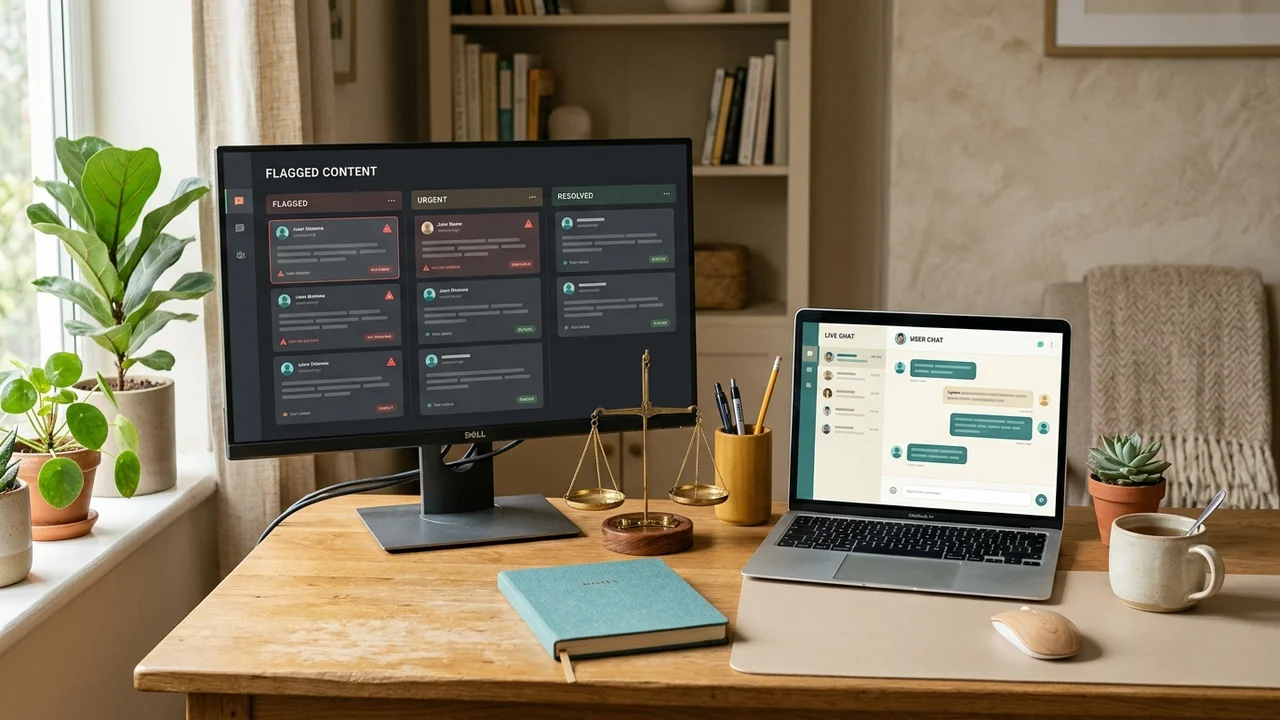
A moderator’s job is to keep a community usable. On a shift you watch live feeds in Discord servers, Twitch chats, forums, or brand communities, and you act when something breaks the rules: delete the message, mute or ban the account, cool down an argument before it becomes a pile-on, escalate anything serious to staff. You’re a referee — mostly invisible when things go well, decisive when they don’t.
The realistic picture, from open listings: pay runs $10–18/hour, and full-time averages track higher on Indeed’s moderator salary data. But two things the listings undersell. First, a large share of moderation work is part-time, project-based, or filled informally from inside communities — the paid-full-time segment is smaller than the search volume for “chat moderator jobs” suggests. Second, openings concentrate on night and weekend coverage, because that’s when communities are busiest and staff are asleep.
Where the real jobs are: platform and studio career pages, moderation agencies like ModSquad and LiveWorld, and — genuinely — being an active, sensible member of a community that later needs paid staff. The emotional cost is real too: you read the worst messages so others don’t have to, and the job selects for people who can stay level while strangers are not.
What does a chat operator actually do?
An operator’s job is the opposite pole: instead of policing conversations, you create them. At ChatQuip, operators hold friendly text conversations with users on partner social and dating platforms — the conversation itself is the product. No calls, no video, ready-made profiles; the full role description is on the vacancy page.
A shift looks like this: you log into the platform during hours you chose yourself, pick up conversations, and keep them alive — asking questions, reacting, carrying the thread. You’re rewarded for engagement: how long users keep replying to you. That makes the skill set closer to being a good correspondent than a good referee — curiosity and warmth in writing matter more than rule knowledge.
The honest trade-offs I give every candidate: earnings depend on consistency (the grade system rewards operators who keep their weekly slots), the content is adult-adjacent flirtatious conversation on some platforms — decide up front whether that’s comfortable — and the work builds conversational craft rather than a corporate résumé line. Entry is genuinely open: English B1+, age 18+, a computer, and free training that takes 5–10 days and is already paid at the Trainee grade.
Which role fits you? Two profiles
The night-owl community native. You already live in Discord or Twitch culture, you know the rules of your communities by heart, and staying calm while other people melt down is your superpower. You want predictable hourly pay and don’t mind — maybe prefer — night shifts. Moderation is your lane, and your fastest route in is the community you’re already active in, not a job board.
The flexible earner. You’re a student, a parent, or fitting work around another commitment. You need to choose your own hours, you want pay that grows as your skill does rather than a flat hourly cap, and open-ended conversation sounds like energy, not drain. Operating fits — and the step-by-step guide to becoming a chat operator shows exactly what the path from application to first payout looks like.
If neither profile is quite you, both roles sit inside a wider set of entry-level options — our ranking of remote jobs that need no experience compares chat work against tutoring, transcription, AI rating, and more.
How does the pay really compare?
Moderation pays like a job: $10–18/hour in open listings, arriving as predictable shift income. At 25–30 hours a week that’s roughly $1,000–1,400 a month near the top of the band — solid, flat, and capped: the hourly rate rarely climbs much with tenure, and the paid ladder above senior moderator is short.
Operating pays like a craft: lower at the start, higher at the ceiling. The ChatQuip grade ladder runs $250–400/month at Trainee (during training), $500–800 at Junior (reached in about 2 months), $900–1,400 at Middle (about 6 months), and $1,600–4,800 at Senior (about a year). The average across our 800+ operators was $1,340/month in Q2 2026 — already above a typical moderation month — and payouts are weekly, from a $50 minimum, with the first payout within 14 days. The full grade table with hourly scenarios is on our salary page.
The crossover point matters more than the ceilings: a Middle operator at six months typically earns what a near-top moderator earns, and Senior operators earn what no moderation listing offers. The trade is those first two months, when a moderator’s hourly wage beats a Trainee’s stipend.
How to move from moderation to operating
I see this switch regularly in interviews, and it works because the hard skills already transfer: fast accurate typing, reading a stranger’s tone from three lines of text, staying composed when a conversation turns weird. If you’ve moderated, you’ve trained all three under worse conditions.
What actually changes is direction. A moderator reacts and removes; an operator initiates and sustains. In training, ex-moderators most often need to unlearn brevity — a moderator’s perfect message is short and final, an operator’s perfect message opens the next reply. Expect that adjustment, not a technical one.
The practical path: check you meet the bar (18+, written English B1+, a computer and stable internet), apply to the chat operator vacancy, pass a short interview and test task, then complete the free 5–10 day training — paid at Trainee grade, so the switch never costs you an unpaid week. Your moderation background is worth mentioning in the application: it signals exactly the temperament we screen for. And in the other direction it works too — some operators later take moderation shifts for variety; nothing about either role locks you in.
Frequently asked questions
What is the difference between a chat moderator and a chat operator?
Which pays more, chat moderation or chat operating?
Do chat moderator jobs require experience?
Can a chat moderator become a chat operator?
Are both roles fully remote and text-only?
Ready to start earning?
Apply in 2 minutes — get a reply within 24 hours.
Apply NowRelated articles
Comparisons
9 Best Jobs for Introverts in 2026: Remote, No Phone Calls
Nine best jobs for introverts in 2026, ranked by how much talking each needs, real pay and entry bar. All nine are remote; five involve zero phone calls.
Comparisons
9 Overnight Work-From-Home Jobs That Pay Weekly (2026)
9 real overnight work-from-home jobs for 2026 — night chat operator, moderation, support, transcription — with pay ranges, where to apply and payout speed.
Comparisons
Remote Chat Jobs in 2026: Every Type Compared, With Real Pay Ranges
A complete map of remote chat jobs you can do from home in 2026 — customer service chat support, chat moderation, entertainment chat operating, sales chat, and AI chat training — with realistic pay ranges, entry requirements, where to apply, and the scam patterns to avoid. By ChatQuip Head of HR Elena Marchenko.