Comparisons
Remote Chat Jobs in 2026: Every Type Compared, With Real Pay Ranges
Published: Updated:

Written by
Elena Marchenko— Head of HR
6 years in operator recruiting, 1,200+ interviews conducted at ChatQuip.
Quick answer
Remote chat jobs fall into five families: customer service chat support (~$15–22/hour), chat moderation ($10–18/hour), entertainment chat operating ($250–4,800/month by grade), sales/lead chat ($15–25/hour plus commission), and AI chat training ($15–30/hour). All are text-only work from home; the main entry requirements are written English (B1+ for most roles) and a reliable computer. Entry-level hiring is real: most of these roles need no degree and no prior experience.
I’m Elena Marchenko, Head of HR at ChatQuip. Over six years and 1,200+ interviews, I’ve noticed most applicants don’t actually know the market they’re entering. They’ve seen one listing — “get paid to chat!” — and have no idea there are five distinct kinds of remote chat work, with completely different pay models, schedules, and hiring bars.
So this is the map I wish every applicant had: every type of chat job you can do from home in 2026, what each really pays, who each suits, and where the traps are. ChatQuip hires for exactly one of these five categories, and I’ll be clear about which — for the others, I’ll point you to where the real jobs live.
The five types of remote chat jobs
| Type | Typical pay (2026) | English needed | Experience | Schedule |
|---|---|---|---|---|
| Customer service chat support | ~$15–22/hour | B2+ (often fluent) | Entry-level, trained | Fixed shifts |
| Chat moderator | $10–18/hour | B1–B2 | Entry-level | Shifts, often nights |
| Entertainment chat operator | $250–4,800/month by grade | B1+ | None, free training | Flexible, min 4 h/day |
| Sales / lead chat agent | $15–25/hour + commission | B2+ | Some sales help | Business hours |
| AI chat trainer / rater | $15–30/hour, project-based | B2+ | None to some | Fully flexible |
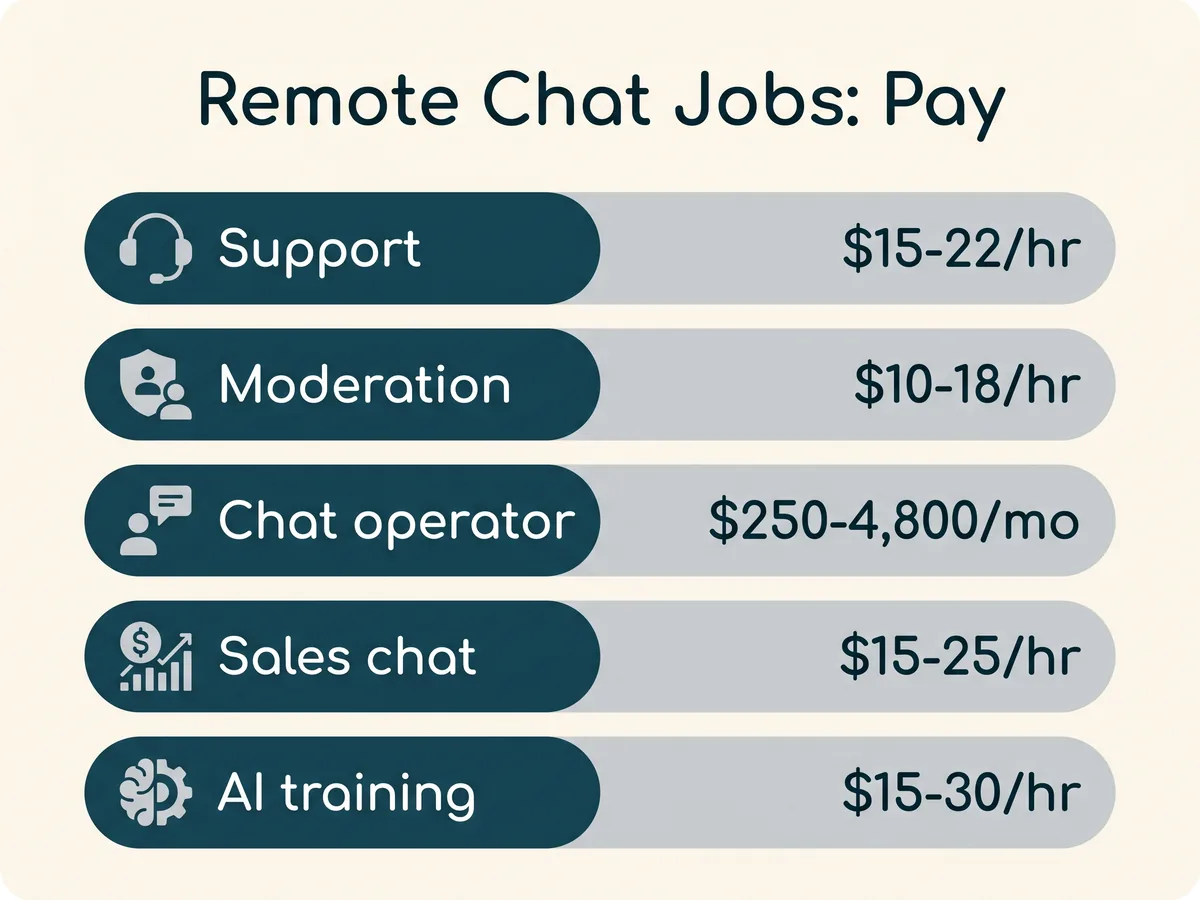
Market hourly figures are estimates from aggregator listings (Indeed, ZipRecruiter) and vary by country and employer; the entertainment-operator figures are ChatQuip’s own grade bands, with the Q2 2026 average at $1,340/month across 800+ operators (internal data).
1. Customer service chat support
The biggest category by far. You answer customer questions in a company’s website chat — order status, refunds, account problems — usually handling two or three conversations at once inside tools like Zendesk or Intercom.
The realistic picture: pay is steady (~$15–22/hour in US listings), the work is structured, and there’s a career ladder into team-lead and support-ops roles. The trade-offs: schedules are fixed and often include weekends, many “remote” listings are country-restricted (US-only benefits and tax setups are common), and hiring is competitive because every laid-off office worker applies to these first. Fluent, near-native written English is usually expected.
Where the jobs are: Indeed and ZipRecruiter for volume; We Work Remotely and Remotive for higher-quality distributed companies. Search “remote chat support” and filter out anything blended with phone duty if you want text only.
Best fit: you want a conventional employer, predictable hours, and a résumé line that transfers anywhere.
2. Chat moderator

Moderators keep communities usable: removing rule-breaking content, cooling down arguments, escalating serious problems. The demand comes from Discord servers, Twitch channels, game studios, and brand communities.
The realistic picture: $10–18/hour in open listings, but here’s what listings don’t say — a large share of moderation work is part-time, project-based, or filled informally from inside the community itself. The paid-full-time segment is smaller than the search volume suggests. Night and weekend coverage is where openings actually concentrate, which suits some people perfectly.
Where the jobs are: studio and platform career pages, moderation agencies (ModSquad, LiveWorld), and — genuinely — being an active, sensible member of a community that later needs paid staff.
Best fit: you already live in Discord/Twitch culture and have the temperament to stay calm while other people aren’t.
3. Entertainment chat operator
This is the category ChatQuip hires for, so read this section knowing exactly who’s writing it. Operators hold friendly text conversations with users on partner social and dating platforms — conversation as the product, not support for some other product. No calls, no video, ready-made profiles, the full role description is here.
The realistic picture: the pay model is different from everything else on this list — monthly, by grade, scaling with skill. At ChatQuip: $250–400/month while training, $500–800 at Junior (about month two), $900–1,400 at Middle (about month six), $1,600–4,800 at Senior. The average across our 800+ operators was $1,340/month in Q2 2026 (internal payroll data; the complete grade table is on our salary page). Entry is genuinely open — English B1+, age 18+, a computer — and training is free, which is rare in this niche and your single best scam filter (more below).
The honest trade-offs: earnings depend on your consistency (the grade system rewards operators who keep their weekly slots), the content is adult-adjacent flirtatious conversation on some platforms — decide up front whether that’s comfortable for you — and this work builds conversational craft rather than a corporate résumé line.
Where the jobs are: direct employers only — this category doesn’t go through Indeed. How to evaluate whether an operator employer is legitimate is its own article; the short version is at the end of this guide.
Best fit: you want the lowest entry bar, flexible hours around study or family, and pay that grows with skill rather than a flat hourly rate.
4. Sales and lead-qualification chat

The chat window on B2B and e-commerce sites that opens with “can I help you choose?” — that’s a sales chat agent, qualifying visitors and booking demos.
The realistic picture: base pay in the $15–25/hour range with commission on top, so strong performers out-earn support agents. But these roles want persuasion-adjacent skills, usually expect business-hours availability in the company’s timezone, and hiring managers prefer candidates with any sales history — retail counts. It’s the least “no experience” category on this list.
Where the jobs are: listings for “chat sales agent”, “SDR (chat)”, or via agencies that staff live-chat sales for e-commerce brands.
Best fit: you’re competitive, money-motivated, and writing a message that changes someone’s mind sounds fun rather than stressful.
5. AI chat trainer / conversation rater
The newest category and the fastest-growing since 2024: rating AI chatbot replies, writing example conversations, and flagging unsafe outputs for AI labs and data companies.
The realistic picture: $15–30/hour on platforms like DataAnnotation, Outlier, and Appen, fully asynchronous — no shifts at all. The trade-offs are instability (project pipelines start and stop without warning; treat it as income to stack, not a salary), waitlists and qualification tests that filter heavily on writing quality, and no career structure. Many of our own operators run AI-rating work alongside chat shifts in slow hours — the skills overlap almost completely.
Best fit: strong writers who want fully flexible extra income and can tolerate feast-and-famine project flow.
How to actually spot chat-job scams
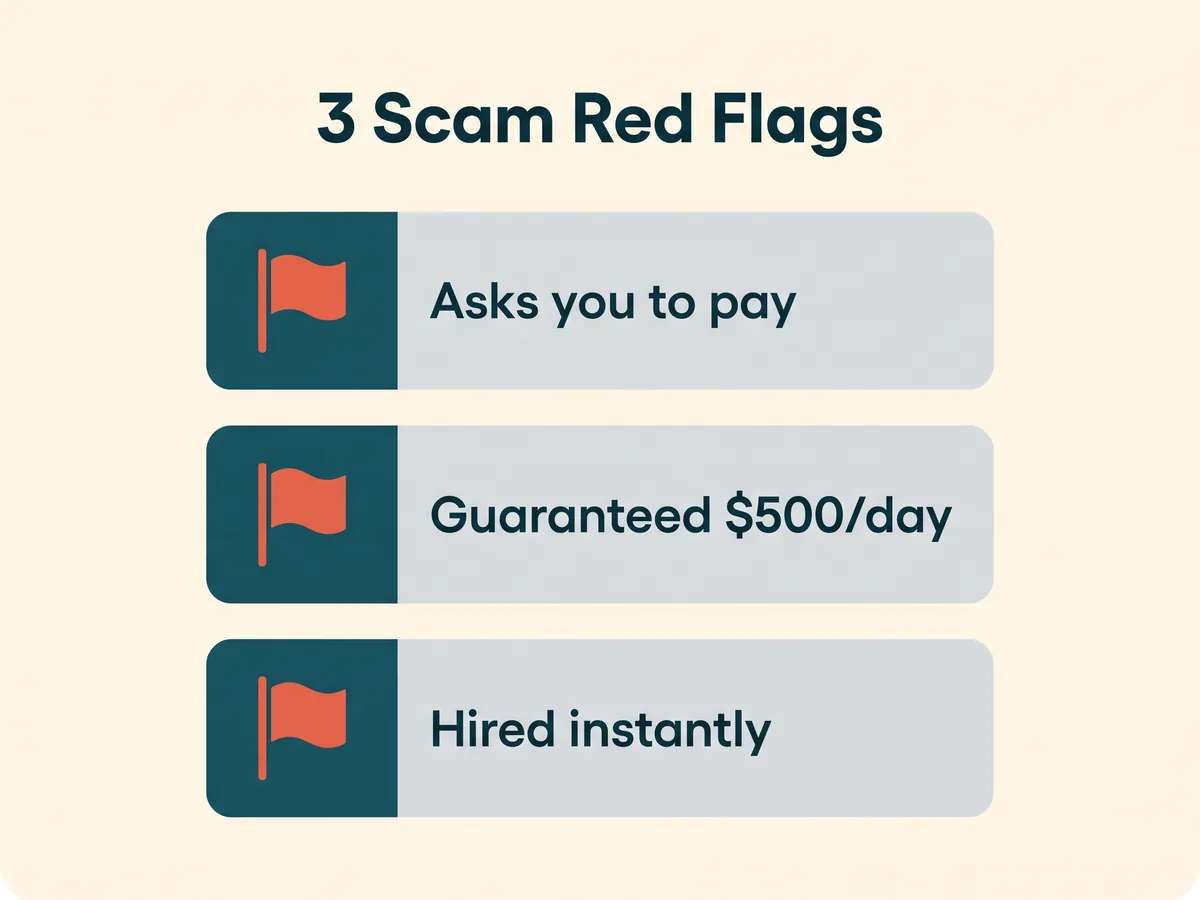
Every category above has a scam shadow, and the same three flags catch nearly all of it:
- You pay them. Training fees, “starter kits”, refundable deposits — a real employer never charges you to begin. This single filter removes most fraud.
- Guaranteed money. “Everyone earns $500/day texting!” Real numbers look like the tables above: modest at entry, growing with skill. Anyone quoting only the ceiling is selling something.
- No hiring process. Instant approval with no interview, no test, no training means your “job” is the scam’s next step — usually check fraud or reshipping. A real process (here’s what ours looks like) takes days, not minutes.
Choosing your lane
If you want a conventional career line, start with customer service chat and work the aggregators. If you’re already embedded in a community, moderation is your shortcut. If your priority is the lowest entry bar with growth-based pay and full schedule freedom, entertainment chat operating is the strongest option — and if that’s your lane, our chat operator role is hiring, with free training and weekly payouts. If you sell well, sales chat pays best per hour. And whichever you choose, AI chat training stacks on top of any of them.
For a wider look beyond chat work entirely, we also keep a ranked guide to remote jobs that need no experience — chat work holds the top spot, but it’s not the only door in.
Frequently asked questions
What kinds of remote chat jobs exist?
How much do remote chat jobs pay?
Can I get a chat job from home with no experience?
Are remote chat jobs legitimate, and how do I spot scams?
Do remote chat jobs require phone calls?
Ready to start earning?
Apply in 2 minutes — get a reply within 24 hours.
Apply NowRelated articles
Comparisons
Top 7 Remote Jobs Without Experience in 2026 (With Real Pay Ranges)
A no-hype ranking of the 7 best remote jobs you can start in 2026 with no experience — chat operator, customer support, data annotation, translation, content moderation, virtual assistant, and online tutoring — each with realistic pay ranges, entry barriers, real platforms to apply on, and honest pros and cons.
Hiring Process
Chat Operator Interview: 12 Real Questions and How to Answer Them
What actually happens in a chat operator interview? Head of HR Elena Marchenko shares the 12 real questions she asks in 20-minute online interviews — with the reason behind each one, what a strong answer sounds like, and the red flags that make her say no.
Pay & Income
How Much Do Chat Operators Make? A Month-by-Month Reality Check (2026)
What does a chat operator actually earn in 2026? Head of HR Elena Marchenko breaks down the real pay by grade — Trainee $250–400 up to Senior $1,600+ — with a full grade table, an hour-by-hour income map, a week-by-week first-month story, and an honest comparison to other remote work.