Hiring Process
Your First Week as a Chat Operator: Day by Day to First Pay
Published: Updated:

Written by
Elena Marchenko— Head of HR
6 years in operator recruiting, 1,200+ interviews conducted at ChatQuip.
Quick answer
Your first week as a chat operator at ChatQuip is training, not a cold start: days 1–2 are onboarding and rules with a mentor, days 3–5 are guided practice on real conversations, and by days 6–7 you are handling live chats that already count toward your pay at the Trainee grade ($250–400/month). Training is free, lasts 5–10 days in total, and your first payout arrives within 14 days of your first paid shift. The one thing that decides whether week one goes well is consistency — steady 4-hour slots beat one heroic day followed by silence.
Key takeaways
- Week one is training, not a cold start: onboarding and rules with a mentor (days 1–2), guided practice on real conversations (days 3–5), then live chats that already count toward your pay (days 6–7).
- Training is free and lasts 5–10 days; its final days are paid practice at the Trainee grade, $250–400/month.
- Your first payout arrives within 14 days of your first paid shift, then weekly, $50 minimum with rollover.
- What decides week one is consistency: four steady slots you never miss beat one heroic day and three days of silence.
I’m Elena Marchenko, Head of HR at ChatQuip. The most useful thing I can tell a candidate who has just received an offer is what the next seven days will actually feel like — because the week is not what most people picture. Nobody drops you into twenty conversations on day one. You start with rules and a mentor, move to guided practice, and end the week handling live chats that already pay. Here is the day-by-day version we walk more than 900 operators through, plus the four mistakes that sink newcomers and the exact moment your first money arrives.
Before day one: what should already be true
You have passed the 2-minute application and the 20-minute written interview, and you have a written offer agreement — read it; it sets out the terms of the work before you commit to anything. You have a PC or laptop and stable internet (a phone is fine for applying, not for shifts), and you have blocked out slots that add up to the 4-hour daily minimum. Nothing has cost you a cent, and nothing will. If any of that is not true, the guide to becoming a chat operator covers the steps before this one.
The week, day by day
| Days | What you do | How you know it went well |
|---|---|---|
| 1–2 | Onboarding: platform tour, conversation rules, what is and is not allowed, your mentor’s contact. Reading and short exercises. | You can explain the three hard rules (no asking users for money, no sharing their details, no contact outside the platform) without looking. |
| 3–5 | Guided practice: real conversations with a mentor reviewing your replies, starting with one or two chats at a time. | Your replies read like a person, not a template, and your mentor’s notes get shorter each day. |
| 6–7 | First paid practice: live shifts in your own slots, several chats in parallel, mentor available for anything that stumps you. These conversations count toward your Trainee pay. | You showed up for every slot you booked. Speed is still low — that is expected. |
Training as a whole runs 5–10 days depending on how fast you settle; the table shows the first seven. The full picture from application to first payout is on the how it works page.
Days 1–2: rules and your mentor
The first two days are mostly reading and short exercises. You learn the platform, the tone we expect, and the narrow set of rules that actually matter: users’ privacy is protected always, you never ask users for money, you never move a conversation off the platform. You also meet your mentor — a working Senior operator whose job for the next week is to answer every “is this okay?” you have. Ask early and ask often; going quiet is the most expensive habit a newcomer can form.
Days 3–5: guided practice
Now you write. You start with one or two real conversations at a time, your mentor reads your replies, and you get notes: too short here, too generic there, ask a question instead of answering with a statement. Two things build in these days — speed and the sense of how many chats you can hold at once without any of them going cold. There is no magic number I grade you against. If a reply starts reading like copy-paste, you have taken on too many.
Days 6–7: first paid shifts
By the end of the week you are on live shifts in the slots you chose, handling several conversations in parallel, with your mentor a message away. These shifts are paid at the Trainee grade — $250–400 a month — so the clock on your first payout starts here, not after some unpaid probation. Expect it to feel wobbly. That is normal, and it passes faster than you think.
The four things that sink newcomers
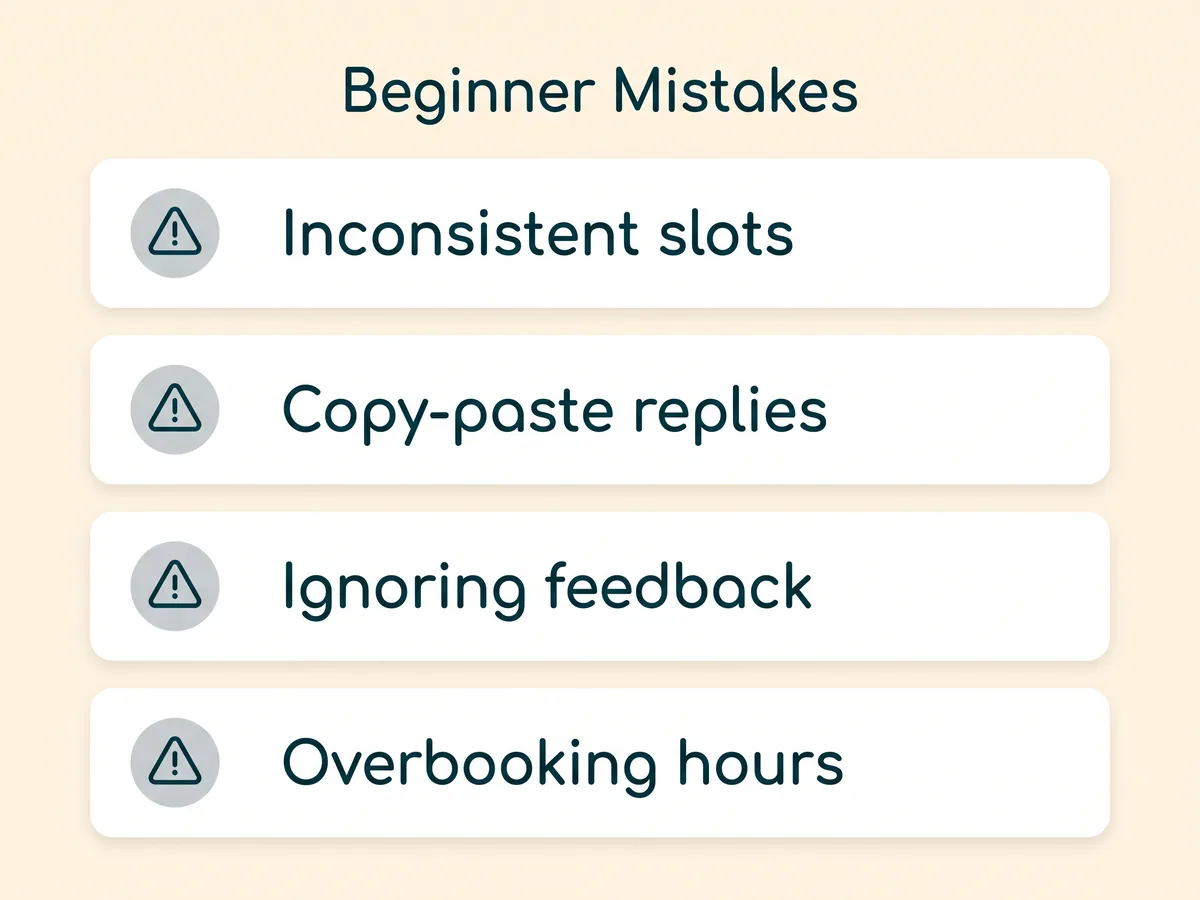
Our Head of Training, David, has seen every version of week one across 900+ operators, and the failures are remarkably consistent. Not weak English, not slow typing — these four:
- Inconsistency. A frantic eight-hour day followed by three days of silence loses to four steady slots you never miss. The grade system rewards showing up.
- Copy-paste replies. The moment a message could have been sent to anyone, the user feels it. Warm and specific beats fast and generic.
- Going quiet instead of asking. Your mentor exists for exactly the questions you are embarrassed to ask. Ask them.
- Expecting Senior money in week one. Week one pays Trainee money. Junior ($500–800) typically comes around month two, Middle ($900–1,400) around month six — the salary breakdown shows the whole ladder.
When the first money arrives
Your first payout lands within 14 days of your first paid shift, by the method you chose — PayPal, crypto, or card. After that it is weekly, with a $50 minimum that rolls over if a light week comes in under it. Nothing is deducted on our side, and nothing was ever charged. The payout methods article has the full mechanics.
After week one
Week two is week one with more chats and fewer mentor notes. The operators who reach Junior fastest are not the fastest typists; they are the ones whose slots were the same every day and whose replies stayed personal as the volume grew. If you can do those two things, the rest is practice.
If you have not applied yet, the chat operator vacancy is open: 2-minute application, written interview with no camera, free training, and a first payout within 14 days. And if the interview is what worries you, the 12 real interview questions are already public.
Frequently asked questions
Is chat operator training paid?
How many chats will I handle in my first week?
What does the first real shift look like?
What most often goes wrong in week one?
Ready to start earning?
Apply in 2 minutes — get a reply within 24 hours.
Apply NowRelated articles
Hiring Process
Chat Operator Interview: 12 Real Questions and How to Answer Them
What actually happens in a chat operator interview? Head of HR Elena Marchenko shares the 12 real questions she asks in 20-minute online interviews — with the reason behind each one, what a strong answer sounds like, and the red flags that make her say no.
Comparisons
9 Best Jobs for Introverts in 2026: Remote, No Phone Calls
Nine best jobs for introverts in 2026, ranked by how much talking each needs, real pay and entry bar. All nine are remote; five involve zero phone calls.
Pay & Income
How Chat Operators Get Paid: PayPal, Crypto, Card, Weekly
How chat operator payouts work at ChatQuip: weekly by PayPal, crypto or card, $50 minimum that rolls over, first payout within 14 days, no fees on our side.